Braden Smearman
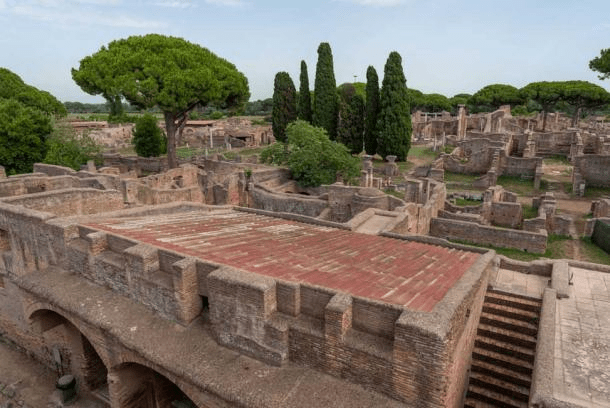
Ostia Antica is an archaeological site located in Rome, Italy. The present-day place is a shell of its former self. Ostia Antica was a Roman port that can be traced back to at least the 4th century BCE. It served as Rome’s principle port for centuries, which stood throughout the rise and fall of the Roman Empire. It stood as a major commercial center and temporarily served as a naval base for Rome. Ostia Antica saw its fall and abandonment around the 9th century CE. In the centuries following, the city was used for building materials elsewhere, but was mostly kept in tact. It was unbothered until the 19th century, where excavations were started. They discovered about two-thirds of the site and created it into an archaeological park open to the public. Due to natural causes over time, the archaeological site is now almost 2 miles inland and about 18 miles west of Rome.
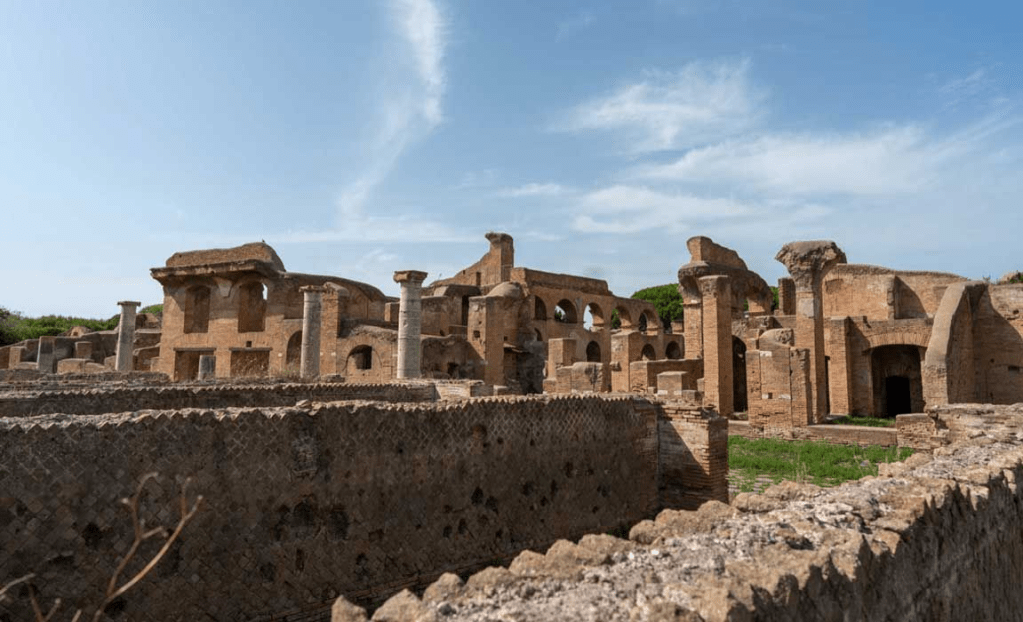
The ancient Romans consider Ostia Antica as their first colony and was founded by Ancus Marcius, who was the fourth king of Rome. He ruled from 640-617 BCE, in which he is said to have founded Ostia Antica about 620 BCE. Due to the fact that some of the site has yet to be discovered, some scholars believe that there was a settlement by the 7th century BCE. It is believed to have been a small outpost, to mark conquered territory. The oldest infrastructure found in Ostia Antica was a road, which has been dated to the 6th or 5th century BCE. This road stretches from the mouth of the Tiber River and continues Southeast. The first structure built at Ostia Antica is called the Castrum. The Castrum was built between 349 and 338 BCE. During this period, Rome was under the threat of pirates and was at war with neighboring societies. It is assumed that Ostia Antica was primarily serving as a naval base during this time period. This is not the only time it has served this purpose, as during the Punic Wars, it served as the main base on the west coast of Italy. After the wars were over, it was converted into a commercial harbor for trade. This is said to occur due to Rome’s growing population and great military success. The port was a central trading hub for societies such as Sicily, Sardinia, and Africa at times. Unfortunately, most of the structures that were built during this period were destroyed because it was completely rebuilt during the 2nd century CE.
Roman mosaics were a common architectural and artistic feature that could be found throughout the empire. They could be found in wealthy, private homes or in public buildings. Some were decorative, while others were built on the floor to provide a durable walking surface. Due to the fact they were walked on, they were made of durable materials such as tesserae, which is a small block of stone tile. This led to archaeologists discovering numerous floor mosaics, making them one of the more common relics found in Ostia Antica. These mosaics were built for the upper class people, which usually depicted some form of royalty or a god. They were built by slaves and lower class workers. Another use of mosaics in Ancient Rome was advertisement. An example of this is located in the Forum of the Guilds. The guilt consisted of merchants, ship-owners, suppliers, importers, and exporters. For the decorative mosaics, most of the preserved mosaics were shipped off to museums, but few still remain on the walls of the complex.
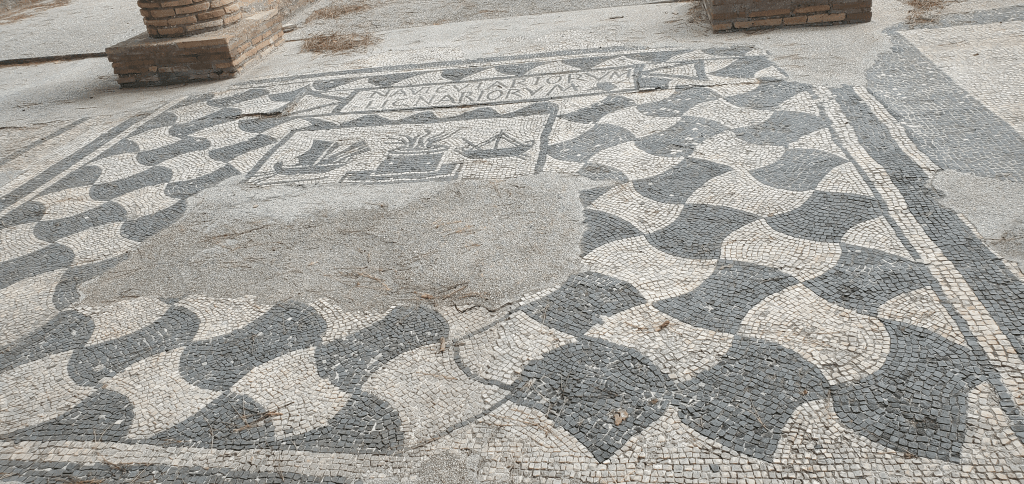
In conclusion, Ostia Antica served as an important city for Rome for several centuries. It served as a commerce center and naval base for certain time periods. It consisted of various forms of art, with mosaics scattered throughout the remains of the city. This includes floor mosaics, which provided a stable walkway, and decorative mosaics, in which most of them have been shipped away. Overall, the design and depictions of the mosaics show the values and important figures in an Ancient Roman society.
Video:
Ostia Antica, Italy: Peek into Ancient Rome – https://www.youtube.com/watch?v=BiCUFlLFazY
Sources:
https://www.ancient-origins.net/ancient-places-europe/ostia-antica-0012792
https://gallivance.net/2014/01/20/mules-gods-and-ad-men-ostia-anticas-mosaics/
 MOSAIC PROJECT 23