By Vasilios Van de Verg

The Alexandrine Parrot Mosaic is a stone mosaic made sometime between 160 and 150 B.C.E. It is one section of a mosaic that once covered the floor of the altar room in Palace V of the Pergamon Acropolis. Pergamon was an ancient Greek city located just outside the modern Turkish town of Bergama. The palace that it was found in was used for official business by the king of Pergamon and was adjacent to both the king’s private residence and the Temple of Trajan. The altar room where the Parrot was found was used for religious ceremonies and sacrifices. This room would be doubly important because it was not only a place of worship, but also as a room in the king’s official building. But why is a mosaic of a parrot in such a significant place? Mosaics were often used as displays of prosperity. The Alexandrine parrot is native to India, and Alexander the Great is said to have sent some specimens to the Mediterranean, where they became a popular pet for noble families. Having the resources to commission a mosaic was a sign of wealth, but to have a mosaic of one of these birds in the palace implied great richness.
Similar mosaics were usually made in sections by multiple craftsmen and then assembled on site. There is another section of Palace V’s floor where a mosaic of a piece of parchment that has “ΗΦΑΙΣΤΙΩΝ ΕΠΟΙΕΙ” or “HEPHAISTION MADE IT” written on it lays. Hephastion may have been one of the craftsmen who worked on the Parrot. It may have also been made, in part, by an artist named Sosos, who is mentioned in the writing Pliny the Elder, and who worked at Pergamon.
The Alexandrine Parrot is a kind of mosaic called “opus vermiculatum”, which is Latin for worm-like work. The technique was developed by the Ancient Greeks and the earliest known example was dated to around 200 B.C. Mosaics of this style are made of curved lines of many small colored tiles, hence the title of ‘worm-like’. The use of small tiles allowed for color gradients and the lines of color give a similar visual effect as does strokes of paint. Individual figures made in this style were often outlined with several rows of tiles of the background color. Most of the works in this style were “emblemata”, or central mosaic panels featuring a figure of a person, animal, or deity, surrounded by a single-color background.

This style of mosaic lent itself particularly well to a subject such as the Alexandrine Parakeet. The Alexandrine Parakeet is a vibrant bird, in both behavior and color. While researching I came across this article about the Alexandrine Parrot: https://lafeber.com/pet-birds/species/alexandrine-parrot/. The gradient of its bright shades is a difficult effect to capture in mosaic, but the small tiles of opus vermiculatum allow for, from a distance, some level of blending between colors. The dissonance between the geometric and very dark background in the mosaic and the organic and bright central figure make the parrot very distinct.


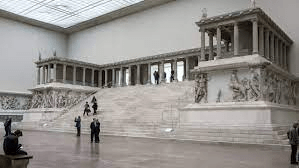
On June 23, 1886, German archeologist Karl Theodor Richard Bohn led a team of excavators in uncovering the floor mosaics in the altar room of Palace V. The mosaic now lies in the Pergamon Museum in Berlin.
Sources:
http://www.my-favourite-planet.de/english/middle-east/turkey/pergamon/pergamon-photos-02-012.html
 MOSAIC PROJECT 23