Peter Bashore

The “Parrot Pergamon” mosaic is believed to be made in the middle of the 2nd century BCE during the spread of Hellenism across the Mediterranean area of Europe. During the Hellenistic Age, mosaics were created and used as the most common form of decoration. They were often found in the rooms most used for entertaining guests, like the dining room. Mosaics were also used to decorate large public buildings, baths, and pretty much anywhere where they could fit one that would be seen. If you would like to learn more about the Hellenistic Age and its art, click here.
The parakeet seen in the mosaic is only part of the floor mosaic as a whole, as there are other portions of the mosaic that I will not be focusing on.
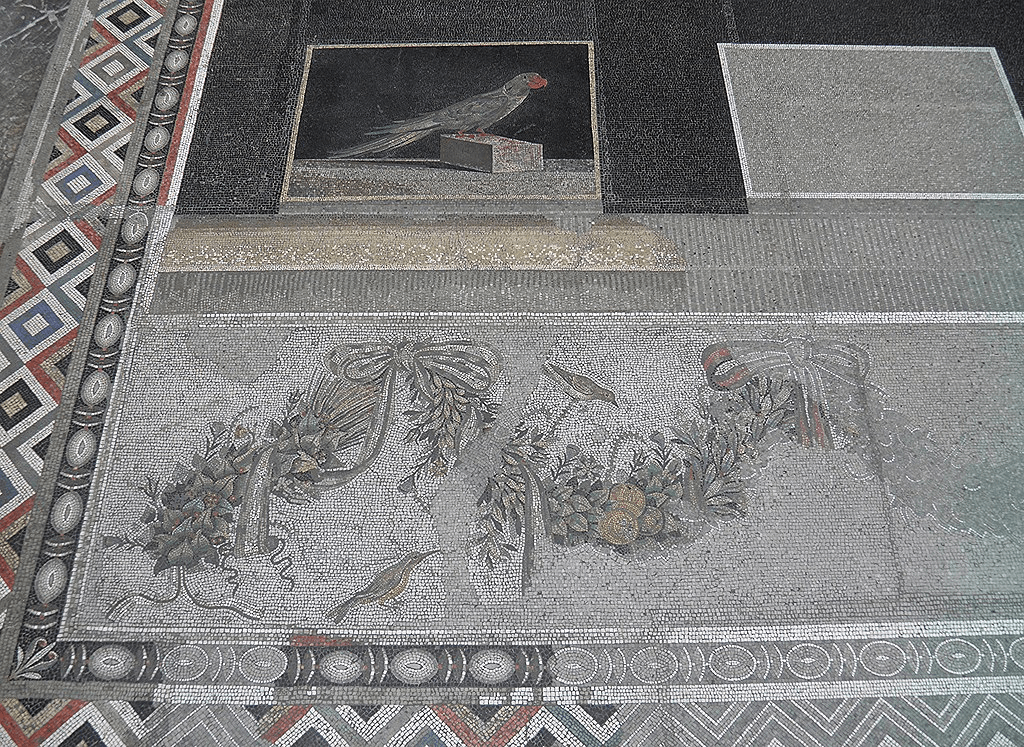
The original version of the mosaic was found in the floor of the altar room of the last royal palace built on the acropolis of Pergamene, also known as Palace V, in modern-day Turkey. It was discovered in 1886 by Richard Bohn and his team of excavators. Some parts of the mosaic were removed in the ancient times, adding to the difficulty of seeing and recreating the entire mosaic. Although the original mosaic cannot be seen today in a museum, a copy of it has been made and is on display in the Telephos Hall of the Pergamon Museum, which can be found in Berlin, Germany. The remaining fragments of the original mosaic are in various conditions, with the head and neck area and the lower feathered area being significantly more deteriorated than the border and background of the mosaic, which have been preserved much better than the main focus of the mosaic, which is the parakeet itself.

The bird depicted in the mosaic and the image below is a ring-necked parakeet, or the Alexandrine Parakeet, named after former Greek ruler Alexander the Great. Alexander the Great brought the parakeets back to Greece after a trip to India. The noble people of Greece kept these birds as pets to show their status.

Unfortunately, the mosaic was created by an unknown artist. It is likely that it was created by a hired mosaicist by the noble people who lived in Palace V.
The mosaic itself is made out of very small stone, glass, and other rocks. This combination of materials is known as tesserae. The tiles are so small that it can be difficult to see the gaps in between each tile if at a great enough distance from the piece. When an artist uses these very small tiles, it allows them to essentially “paint” with tesserae to create their artwork, making it look more clean and together, as well as allowing them to add more minor details to the mosaic. The vibrant colors of the bird allow it to pop more and be the main focus of the mosaic. The use of vibrant colored tiles was commonly seen in Ancient Greece, as the most famous Greek mosaicist from the ancient times, Sosos, also employed this strategy. An outline of the main picture was also commonplace in mosaics at the time, as exhibited in this mosaic. You can see how the black tiles placed around the bird are tilted in a different direction to distinctly outline the bird, similarly to how it is seen in drawing on paper.

Usually, mosaicists would create their mosaics in panels called emblemata. They would create the entire mosaic in their workshops separate from where the mosaic would eventually be placed. They would then move the emblemata from the workshop to the site of where the mosaic will be placed and would have it cemented into the ground using mortar.
The reason for the mosaic being created is not exactly known, although it is likely it was to commemorate the Alexandrine parakeet because of the noble people’s tendency to keep them as pets. The Parrot Mosaic is a relatively mysterious mosaic and is a famous example of a mosaic from the Hellenistic Age.
Works Cited
https://artsandculture.google.com/asset/parrot-mosaic-unknown/dAHr0Sez7P1WiA?hl=en
http://www.my-favourite-planet.de/english/middle-east/turkey/pergamon/pergamon-photos-02-012.html
 MOSAIC PROJECT 23