By Brendan Sipes
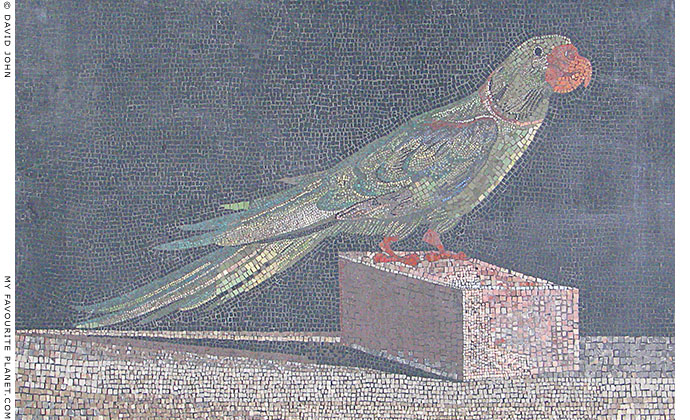
The Parrot mosaic was made in Hellenistic period of Greece around 200 B.C.E. The mosaic was designed after the Psittacula eupatria or Alexandrine Parakeet which was named after Alexander the Great. The bird was “An exotic pet owned by the nobility and the elite”. The Psittacula eupatria is the largest Asiatic parakeet at a size of close to twenty-five inches.

The Greeks first started developing mosaics as a form of art in the eighth century B.C.E. The mosaics were made of stone and were simplistic in pattern. However, The Greeks were highly innovative and made many more intricate and difficult designs by implementing the use of smaller pieces and symmetric patterns into their mosaic work. As time passed, Mosaics became an important symbol of wealth and honor.
The parrot mosaic in the Pergamon museum was made using a special type of Hellenistic style called opus vermiculatum which means wormlike. This means that part of or all of the mosaic was made of small and closely set cubes of stone, ceramic, glass or other materials that are different colors and have fine outlines of a centralized figure. This figure was then surrounded by a geometrical pattern or design.
Here is a video of someone using the opus vermiculatum or wormlike style to create a simple mosaic. You can see the clear center figure made of brown blocks, and a geometric pattern as the background made of different colored blocks to highlight the center piece of the mosaic.
The original parrot mosaic is no longer intact, but the one displayed today is a copy made in 1955. The original parrot has only survived in fragments and was removed from the museum as it had started to decay. This decay caused a need for a reconstruction of the mosaic. The new mosaic that is currently being displayed in the Pergamon Museum in Berlin, was made by using fragments of pieces from other mosaics in the Telephos Hall and integrating them into the original to preserve the artwork.
The artist credited with the creation of the original parrot mosaic in 200 B.C.E is unknown to us due to lack of information regarding the creation of this artwork. However, it is known that this mosaic was originally made as a floor tile, rather than just a piece of art. The mosaic was also made to honor Alexander the Great, which is why the Alexandrine parakeet was chosen as the center piece of the mosaic.

The mosaic is currently located in the Pergamon museum in Berlin, Germany. The Pergamon museum was built from 1910 to 1930 and housed excavated item found by museums in Berlin. It gets its name from one of its main attractions, the altar of Zeus from Pergamon, which was located in present day Turkey. Today, the museum holds Architectual remains, sculpture, pottery, jewelry, and other art from the Greco-Roman (Ancient Greece or Roman) era.
Works Cited:
https://www.britannica.com/topic/Pergamonmuseum
https://www.britannica.com/art/opus-vermiculatum
https://dome.mit.edu/handle/1721.3/146676
phttps://www.thesprucepets.com/alexandrine-parakeets-as-pets-390267ets-390267
 MOSAIC PROJECT 23