Evan Rodgers
Most of my interpretation of the Pergamon Hellenistic Mosaic will be created out of paper. Most, if not all, of the paper will be construction paper. Most ancient mosaics were comprised of tiles fashioned from colored glass or stones; however, I will use construction paper instead because it is cheaper to obtain than these original materials, and I currently have an abundance of the substance on hand. It will be created in the work office of my house. I am currently not expecting the reproduction to be reconstructed in any other part of the building.
The main aspects of the mosaic that I want to recreate are the pose of the parrot, the shape of the individual components, and the general colors of the picture. My first step is to draw the basic outline of the parrot. Second, I will render the details inside the outline, such as the eyes, the talons, and the individual feathers. Next, I would erase and redraw lines to better resemble the tiles used in the original artwork. Once the shapes resemble those of their predecessor, I will color the tiles accordingly. After all these steps, I would have the blueprint of my recreation of the original Pergamon Hellenistic Mosaic. I would then begin the process of creating my replication by tracing the squares of different sizes on green construction paper. Once I have my array of squares complete, I will then cut them out. I will do this several times on construction paper of other colors such as red, yellow, blue, orange, and black. With this task done, I will then lay out the squares in accordance with the colors and position of the original mosaic. Finally, with the general position of paper squares figured out, I will glue the pieces to their corresponding location until the mosaic is fully glued and completed.
The main problem I foresee is that cutting and gluing the paper will be a tedious task. I will attempt to incorporate influences from pixel art techniques, such as anti-aliasing. Anti-aliasing is the technique of using a darker version of the main color as a transition between the inside of an image and the outline. It is used to create less stress on the viewer’s eyes during this conversion. I would use this skill since the art of creating a mosaic is very similar to the process of making pixel art.
I found inspiration the grandeur in the uncovered ancient work below.
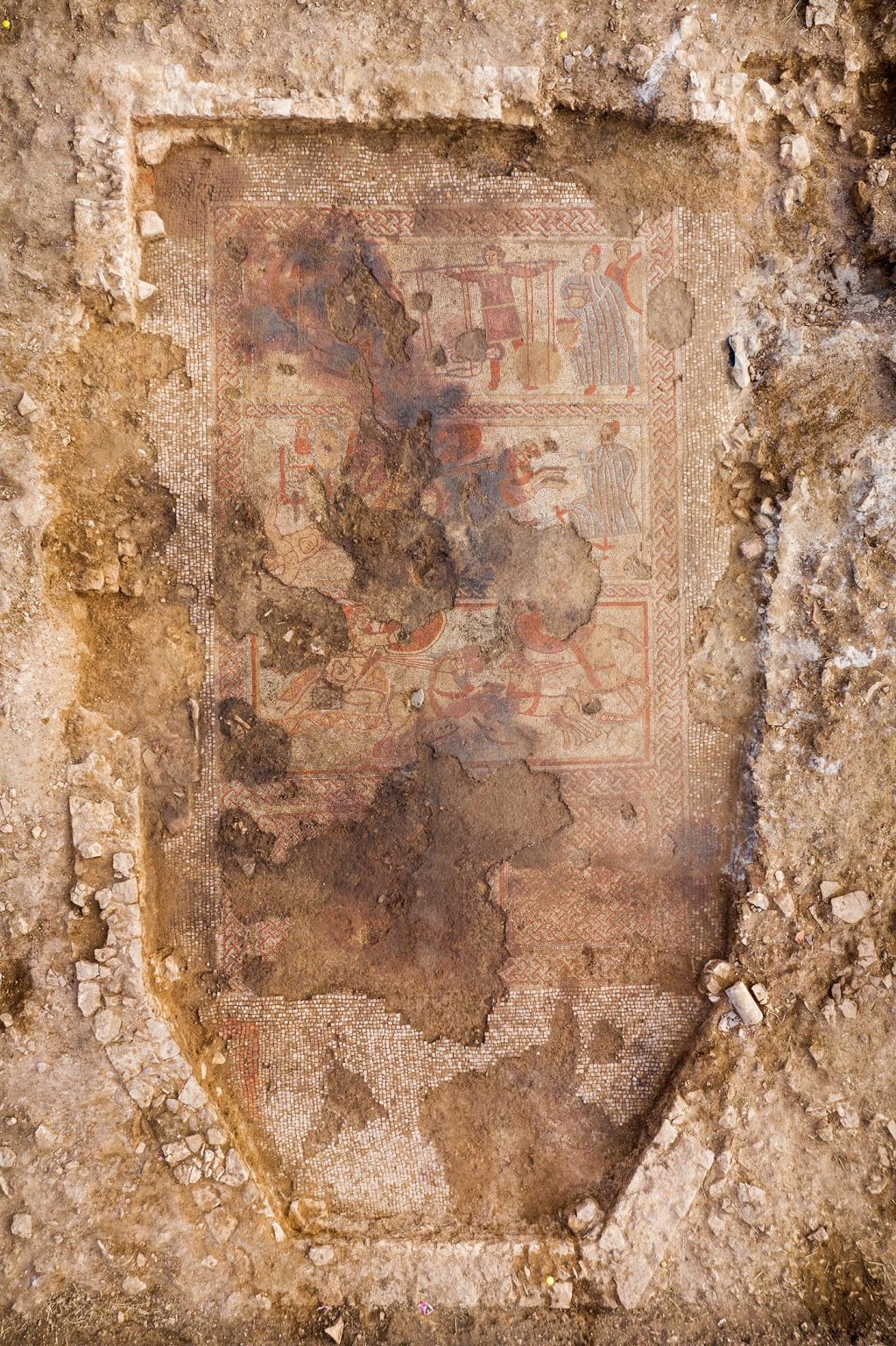
Extraordinary Roman Mosaic and Villa Complex Discovered Beneath Farmer’s Field in England
Ultimately, I want my audience to understand that they can generate great art by keeping a design simple. When examining the original Pergamon Hellenistic Mosaic, one can see examples of miniscule tiles in areas of the wings, neck, and beak. By comparing these areas to my future rendition, I hope the audience can see how I turned a complicated masterpiece into a much simplier yet just as powerful piece of art.
 MOSAIC PROJECT 23