-
Artist Statement: Parrot Pergamon
Eric Meyer

Artist Statement Audio Recording Transcript: I created a recreation of the ancient Greek Parrot Pergamon floor mosaic. The materials I used to recreate the Parrot Pergamon mosaic were paper, pencil, colored pencils, a printed picture of the Parrot Pergamon, scissors, and glue. The purpose of my work is to make my personal recreation of the Greek Parrot Pergamon in a way I feel is representative of my own style. I originally wanted to use paint but found it was too challenging to blend color in small areas, so I chose a different medium with colored pencils that I could blend much more easily and fine-tune detailed areas.
The original parrot was a depiction of an aristocratic nobleman’s exotic pet that was referred to as high status. I wanted to attempt to duplicate the elaborate colors and style of the original piece of art. The parrot as a symbol in the art piece represents the lifestyle of the rich and noble that many people at the time aspired to attain. My sisters’ AP and IB artwork helped influence and expand my creativity and encouraged me to use their favorite medium with colored pencils to create depth and detail to recreate the mosaic.audio clip I chose this audio clip because it gives a reference to the audience of the actual sounds of the bird depicted in my mosaic recreation, the Alexandrine parakeet. This audio clip allows the audience to experience the mosaic with another one of their senses, as it is a recording of the same noises the bird would make as it sits on the box. The parrot’s playful expressions, songs, and oftentimes mimicking words would make this bird an entertaining and engaging pet. I feel its sounds are uplifting, playful, and silly which is a sharp contrast to how the parrot is often preassumed.
- How did the general population at the time when the original artwork was made feel about the Parrot Pergamon?
- What are other ways to recreate mosaics?
- What feelings does the Parrot Pergamon evoke?
-
Final Creation and Artist Statement
By: Brendan Sipes
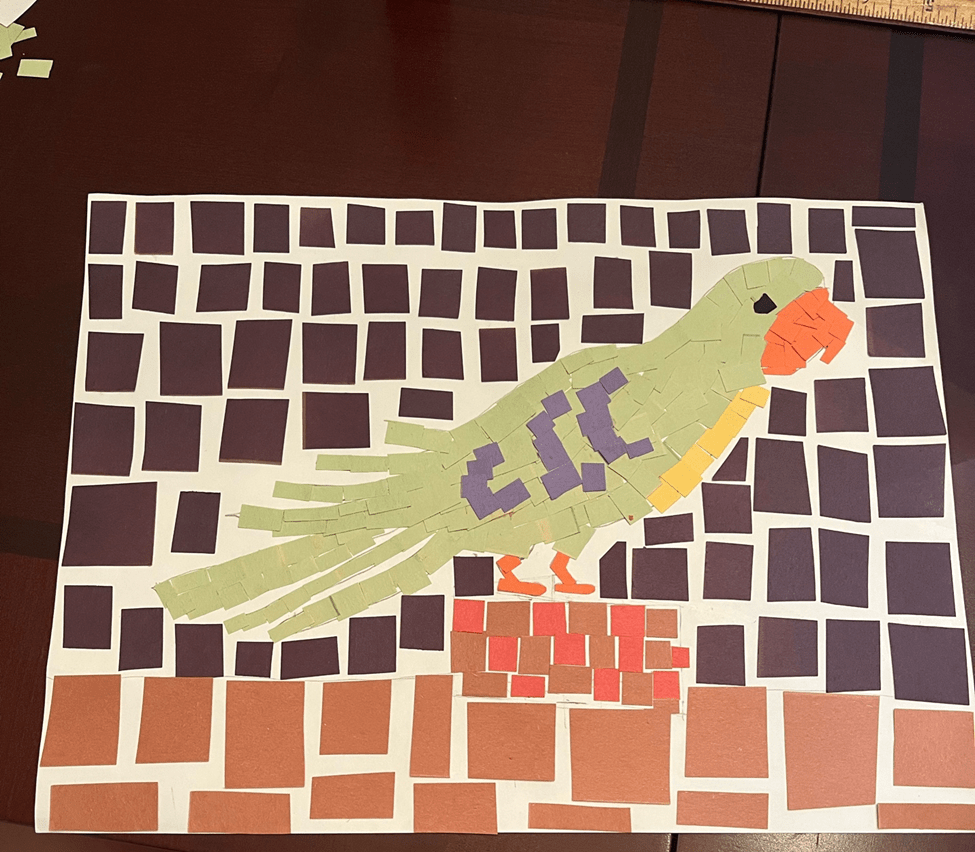
Artist statement script: Hello, I am Brendan Sipes, and I recreated the Parrot Pergamon mosaic. To create this piece, I used construction paper, scissors, a pencil, and a glue stick. The purpose of this work was to replicate the original parrot mosaic but add my own style and process to the piece. I am definitely not as talented as the original artist and aren’t as skilled at creating complex mosaics, but my process was to simplify the mosaic to my skill level and create a recognizable recreation of the original mosaic. One of the main symbolisms of this mosaic is the parrot symbolizing Alexander the Great. The parrot species (Alexandrine parakeet) depicted in the mosaic was named after Alexander the Great and were often owned by wealthy families. The biggest influence on how I created my mosaic was the resources I had at my house. I didn’t have too many different artistic materials in my house to work with, but I did have an abundance of construction paper, so I created my style and plan around my resources.
Audio clip – https://www.youtube.com/watch?v=XM2sOfUSjQY
I chose this jungle sound to further experience my artwork because of its soothing tone and the sounds of different birds and nature in the background. When I look at the parrot mosaic, I always feel like I am hiking in a big, tropical rain forest and can see and hear all of the different birds and animals. I thought these jungle sounds perfectly resembled what I imagine hearing when observing the mosaic and really made me feel like I was actually in nature watching and experiencing all of the different birds and animals moving about in their natural habitats.
Discussion Questions:
- Looking back, I defiantly would have done things differently to create my mosaic. Do others feel the same way?
- What aspects of the mosaics did you try to accurately represent in your work, and what aspects did you change?
- What were the most challenging parts of creating your mosaics?
-
Christopher Geldmacher’s Artist Statement

Fully completed recreation of piece of Baths of Neptune I chose to recreate a small piece of the Baths of Neptune mosaic from the ancient Roman city of Ostia Antica. To achieve this, I cut out pieces of black construction paper and glued it to a larger sheet of white paper that I drew an outline of the design on. The purpose of this work is to not only display a fish, but to inform the audience of the important and relevance of the sea in the lives of the ancient Romans living in Ostia Antica. The town was a port city, and had a high traffic of merchants, travelers, and naval ships. This brought prosperity to the town, as shown by the mosaics that were created. The themes surrounding this artistic piece are water and simplicity. The water is not directly shown, but is implied in the background of the tessellation, and relates to the previous mentioned significance of the ocean. The simplicity of the art is another strong theme, as it demonstrates how things do not have to be complicated or exceedingly sophisticated to be enjoyed.
Connection to the Van Gogh Immersive Experience Mosaic:
The mosaics from the Van Gogh Experience had one massive distinction from my mosaic; they were entirely digital and projected. The point of the Van Gogh Experience was to allow the audience to see and learn about Van Gogh’s artwork in a different way, a digital setting. It was projected all over the walls, ceiling, and floors, and brought a newer and deeper meaning to his masterpieces.

Extra Audio Clip; https://www.youtube.com/watch?v=V1RPi2MYptM
These sounds and songs add to the experience of my piece by putting the audience’s mind at rest while listening to sounds that relate to water. As I have stated, that’s pretty much what this entire mosaic is about. Giving the audience a way to really understand the piece using more than one sense adds to the overall quality and enduring of the process. It allows for the mind to wander and think about what else could be in mosaic, what could be added, and initiate new ideas and thoughts they may not have come without having that extra outside force (the music) acting upon you.
Questions
I had to improvise when troubles arose surrounding how I was actually going to create my mosaic, did anyone else have a similar experience?
What caused you to use the materials that you did?
Would you ever do something like this again given the chance?
-
Artist statement: Beans-ified
Peter Kelly 11/4/22
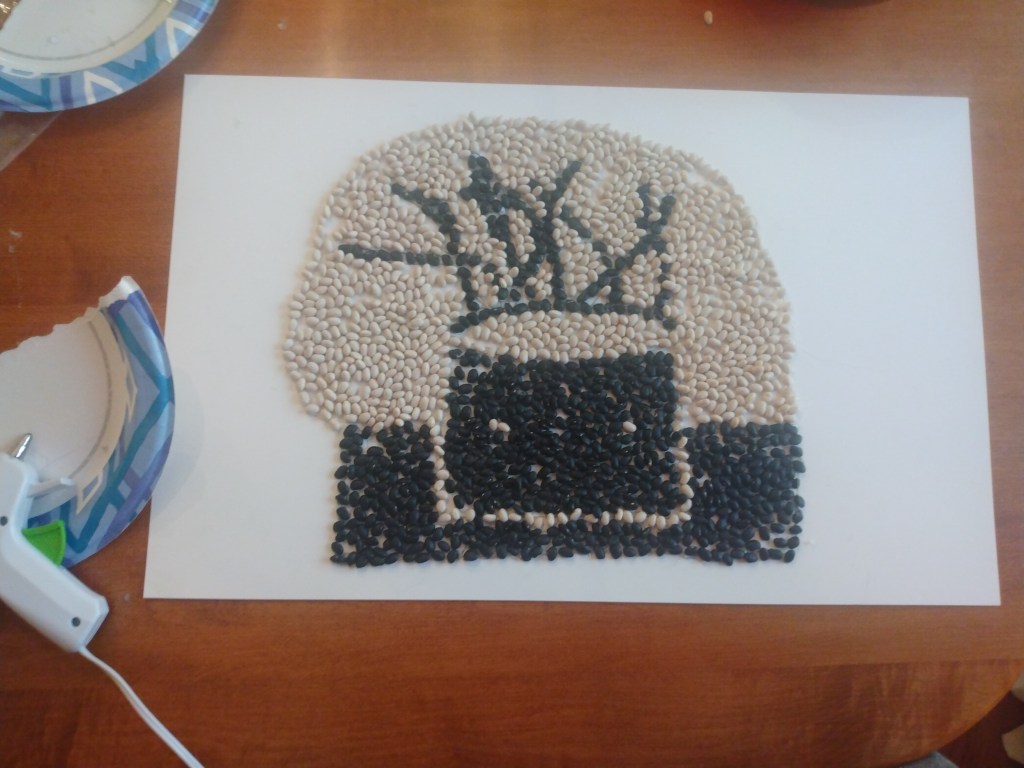
It is done! All the beans have been glued except most of them.
Hi, I’m Peter Kelly, and I glued down some beans. It is not a coincidence that the beans come together to resemble an ancient Ostia Antica mosaic, nor is it a coincidence that these mosaics were often used to display goods being sold at a group’s shop, nor is it a coincidence that mosaics like this were extremely popular and are still admired today. I embarked on this journey as one adolescent, with some beans and a dream, but I left with the beans glued down to some posterboard. I used hot glue to stick a border of beans around an area, and filled in that area with some more beans. My main purpose of this work was to closely replicate the mosaic, while still adding my own flair. I tried to replicate the colors and shape of the mosaic, and through my replication I displayed the mosaic’s original meaning. I also did not want a zero. A main theme of this mosaic is the reliance of poor merchants on these mosaics to advertise their products, essentially depending on the effectiveness of these mosaics. I expressed this by making the colors pop and the shape very clear. I think it is very symbolic how I used food to replicate a mosaic that often signified food being sold and effectively put food on the table, as I said earlier. My influences include Ellsworth Kelly, who tended to use vibrant colors, but often resorted to black and white art. Kelly was an abstract artist, as can be seen in his “White and Black” (1952). There is even a book compiling all of his black and white paintings, showing how he valued shape and contrast, much like the mosaic.
Here is my video, where I say the exact same thing.
video where I explain my artist statement song to be listened to while looking at my beaned mosaic This is a song that I greatly enjoy. While I do not normally listen to this style of music, I think it is a great song. This is symbolic of how I do not normally make mosaics, but I enjoyed it nevertheless. The song is very upbeat, which reflects the mood I want to evoke and have the viewers of my art feel. The title is ‘Summit’, and I felt like I reached the summit of my creativity when I was finished with my mosaic. I felt very triumphant, just like the song. Even if you don’t normally like this type of music, you should still listen to it because it goes very well with my mosaic. While the actual sound of the song may not relate as much, the mood, pace, and tones reflect the themes of my mosaic.

This is my picture of the floor from the Van Gogh exhibit. When Van Gogh’s “The Harvest” appeared on the walls, wheat rushed on the floor all around the viewer, in an effort to engage the observer. I think Van Gogh tried really hard to make this look good, but deep down he knows that he can’t compete with my artistic genius. That’s why the creators of the exhibit had to make his art dynamic, to try to best me. I can convey a beautiful message without movement. I’d like to see Van Gogh use a hot glue gun as expertly as I can. It can’t be done; no one can match my dexterity and deftness.
Questions
- I know I ran into challenges early on in the creation process, but I was able to adapt and change my plan of attack. Is that something that anyone else experienced?
- Did anyone listen to music or watch something else while constructing their mosaic? I do this because it helps me focus, but I’m interested in how other people lock in and what they use to get themselves in the right mindset.
- How did people reflect on their mosaic? Did their interpretations of the meaning change as they were creating it?
-
Artist’s statement
-jack geibler
Transcript: This image of a dolphin is a part of the dolphin series in an island called delos. A man named Asclepiades created it but not very much is known about him. To recreate this, I used a piece of cardboard, thick paper, hot glue, and colored rocks. This is my personal replication of the mosaic. Obviously I couldn’t make it exactly how it was in the photo because my artistic ability is not on that level. I did things like precisely place my rocks and make sure that the colors were vibrant to bring it to life. The colors were brighter because I wanted to make my mosaic look as it did when it was created. The mosaic represents a story of dolphins saving a military hero from drowning. I was inspired to use rocks for my mosaic because I immediately thought of the rocks at the pond near my house when given the assignment. I thought they could be matched up well to create the mosaic and have that same stone look to it.
Choice of music: I chose “Ocean eyes” by Billie Eilish because it brings a serene look upon the mosaic. When looking at a piece of art, the music should be light because it isn’t the main focus. “Ocean eyes” has a lighthearted sound to it. This helps with a good experience while looking at the art. Also, this connects to the story behind the mosaic. When someone has ocean eyes that means that their eyes are being compared to a beautiful picture of the ocean. That’s what comes to mind when I think of the dolphin saving the warrior. Overall, this song is good for the mosaic chosen.
Guiding questions:
for those of you who planned the whole assignment out beforehand: do you think that was a key factor to your success?
What is the best technique for recreating each mosaic?
Could creating the mosaic and then piecing it up be easier to keep the image accurate?
Why the hell does hot glue dry so fast?
-
My Final Product and Artist Statement
By: Connor Bravo
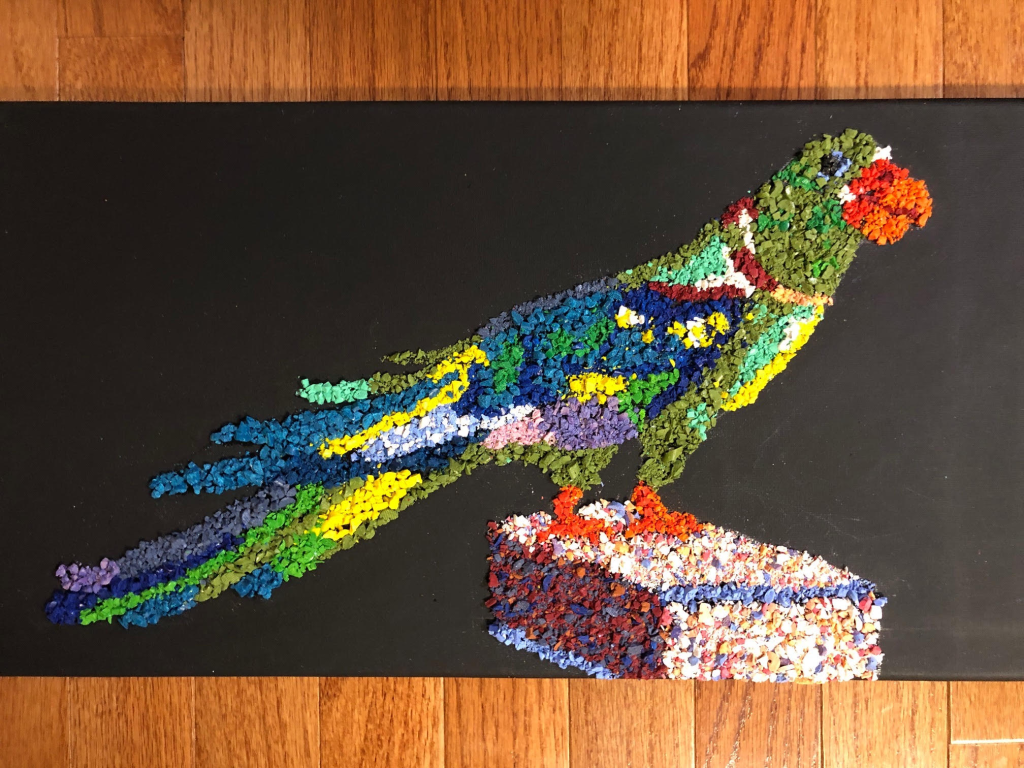
My Finished Product Audio Clip Audio Clip Transcript:
I, Connor Bravo, chose the Parrot Pergamon mosaic to recreate. This mosaic was found in some of the most famous ancient buildings in Pergamon. I really enjoyed and tried my best in recreating this mosaic, even though it did take up some time. To recreate this mosaic, I used crushed up crayons and glue to make the mosaic look as similar to the original as possible. I would put glue on a canvas and spread the different colored crayons all around to make it look like the original tiles. My purpose for recreating this mosaic is really just to bring back some of the ancient Hellenistic art, and put a modern twist on it today. The ideas that the work explores just sparks that new interest in recreating art in ways never done before. This would ultimately increase the popularity for older art and increase the amount of new art being recreated today. This recreation of the mosaic proves that there can still be new masterpieces of new art being created or old art being recreated today. One main symbolism that is in this mosaic is the bird symbolizing Alexander the Great. It was named Alexandrine parakeet after Alexander the Great because of how many he sent over to the west. The birds became symbolism for rich and noble families with whoever owned one. Looking up other crayon artists on YouTube was a big influence in showing how things like these can be done really well just by using crayons. They showed how it can be a hard process but still pay off in the end. Recreating this mosaic had its ups and downs, but the important part was that I finished it and it looks pretty good.
Music Clip Music Clip Relation:
My music clip relates to the experience of my mosaic because of how relaxing it is, the use of ambient bird noises in the background, and including ambient noises of nature. Having this light and relaxing music adds to the mosaic because it makes the listener visualize how peaceful it would be if someone was just bird watching these types of birds. Having the ambient bird noises gives the listener an idea on how the bird may sound and give life to the bird on the canvas. The ambient noises in nature really just adds to the atmosphere and makes the listener feel as though they are in India trying to find one of these birds.
Mosaic Final Montage Questions:
What was your plan/process in order to create your work-in-progress clips or videos? Did it take you long to come up with a good way to show it?
What is one recreation of a mosaic that really stands out in the art walk? Why does it stand out so much and why is it so eye-catching?
What were the easiest parts and hardest parts of trying to display your mosaic for a nice image for all of us to see?
How were you able to find the right angle or shot to show off your mosaic properly? What were you trying to accomplish with those specific shots?
-
Alexandrine Parakeet: The Artist’s Statement
By Vasilios Van de Verg

This is my recreation of the Alexandrine Parakeet Mosaic of Pergamon. I remade the mosaic out of overlapping strips of paper for the body of the parrot and glass and ceramic for the background. I paired these two materials in order to accentuate their properties; the paper strips are flexible and irregular, in sharp contrast to the static and periodic ceramic around them. It was my intention to use two very disparate mediums side by side, in order to display a disconnect between the parrot and the rest of the mosaic. While I was studying the original artwork, it struck me how alien the parrot seemed. Its vibrant colors and the almost organic appearance of opus vermiculatum opposed the coldness and the rigidity of the surrounding tiles. It was almost like looking at two different mosaics, which is an effect than I attempted to not only replicate but to enhance. The presence of a singular figure surrounded by a dark, overpowering background displays an air of isolation, which is further compounded by the distinct material and style of the figure.
Audio for Artist’s Statement Parrot callings, to be listened to while viewing the artwork. Firstly and most forwardly, listening to the call of a parrot immerses the audience by creating another sensory connection to the main figure of the mosaic. This adds to the liveliness of the parrot and makes the contrast between it and the background all the more stark. Furthermore, it should be noted that the cries come from a lone parrot, which serves to magnify the atmosphere of solitude exhibited by the piece. When combined, the distinct visual quality of the paper portrait and its accompanying audible component create a close approximation of a parrot from the audience’s perspective. This may cause the viewer to think about the original parrot. Not the original mosaic of the parrot, but rather the parrot that was used as a reference for the original mosaic. That parrot was bright, alive, animated, colorful, and its nature was altogether foreign to dark, cold, rigid stone.
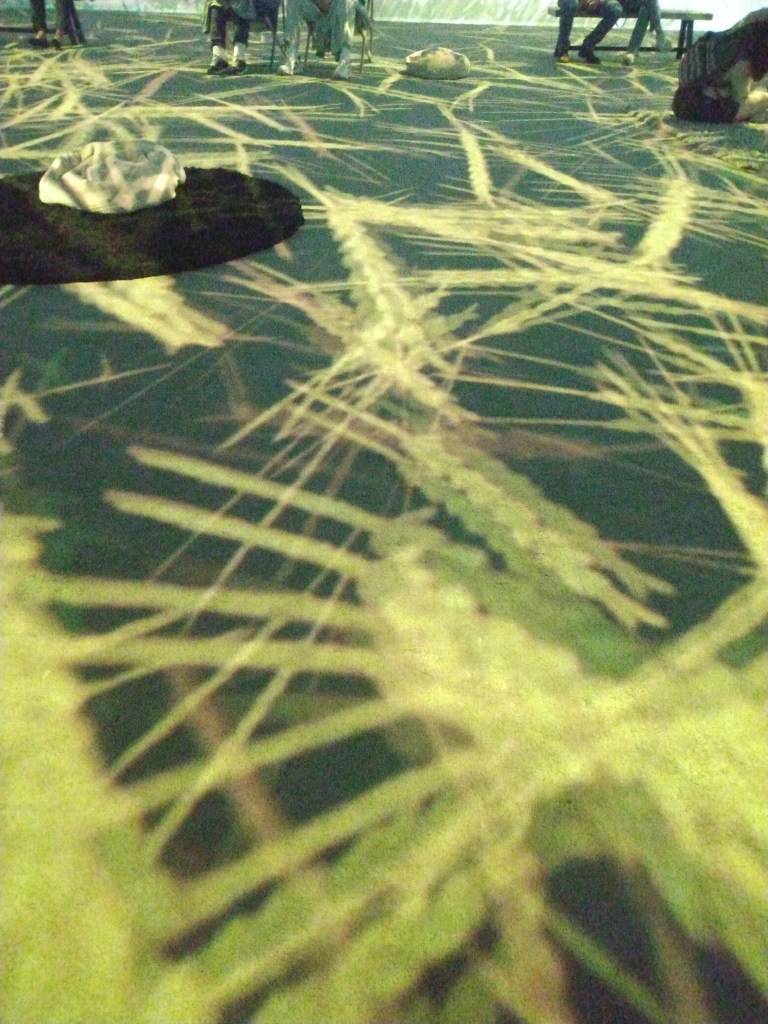
This is a photo of the floor in the Van Gogh Immersive Experience in Washington DC. It relates to my mosaic because the way that the projections of the wheat are superimposed on the dark floor is similar to the way I superimposed the parrot on the dark glass.
Working on this project has raised a few questions for me. Firstly, why do many of our artworks mimic those of antiquity? Is it possible that this tendency to mirror the past is in opposition to Gertrude Stein’s belief that art should be separate from the identity of the artist, as relying on inspiration from classical civilization inherently ties its identity it to western culture? Secondly, what does the confinement of the parrot say about our perception of beauty? While putting a radiant object in the center of a drab scene does magnify its visual qualities, is it not also true that this detracts from the objects beauty and creates an air of somberness? Are not magnificent things better when in conjunction with each other?
-
Artist’s statement
-jack geibler
Transcript: This image of a dolphin is a part of the dolphin series in an island called delos. A man named Asclepiades created it but not very much is known about him. To recreate this, I used a piece of cardboard, thick paper, hot glue, and colored rocks. This is my personal replication of the mosaic. Obviously I couldn’t make it exactly how it was in the photo because my artistic ability is not on that level. I did things like precisely place my rocks and make sure that the colors were vibrant to bring it to life. The colors were brighter because I wanted to make my mosaic look as it did when it was created. The mosaic represents a story of dolphins saving a military hero from drowning. I was inspired to use rocks for my mosaic because I immediately thought of the rocks at the pond near my house when given the assignment. I thought they could be matched up well to create the mosaic and have that same stone look to it.
Choice of music: I chose “Ocean eyes” by Billie Eilish because it brings a serene look upon the mosaic. When looking at a piece of art, the music should be light because it isn’t the main focus. “Ocean eyes” has a lighthearted sound to it. This helps with a good experience while looking at the art. Also, this connects to the story behind the mosaic. When someone has ocean eyes that means that their eyes are being compared to a beautiful picture of the ocean. That’s what comes to mind when I think of the dolphin saving the warrior. Overall, this song is good for the mosaic chosen.
Guiding questions:
for those of you who planned the whole assignment out beforehand: do you think that was a key factor to your success?
What is the best technique for recreating each mosaic?
Could creating the mosaic and then piecing it up be easier to keep the image accurate?
Why the hell does hot glue dry so fast?
-
Artist’s statement
-jack geibler
Transcript: This image of a dolphin is a part of the dolphin series in an island called delos. A man named Asclepiades created it but not very much is known about him. To recreate this, I used a piece of cardboard, thick paper, hot glue, and colored rocks. This is my personal replication of the mosaic. Obviously I couldn’t make it exactly how it was in the photo because my artistic ability is not on that level. I did things like precisely place my rocks and make sure that the colors were vibrant to bring it to life. The colors were brighter because I wanted to make my mosaic look as it did when it was created. The mosaic represents a story of dolphins saving a military hero from drowning. I was inspired to use rocks for my mosaic because I immediately thought of the rocks at the pond near my house when given the assignment. I thought they could be matched up well to create the mosaic and have that same stone look to it.
Choice of music: I chose “Ocean eyes” by Billie Eilish because it brings a serene look upon the mosaic. When looking at a piece of art, the music should be light because it isn’t the main focus. “Ocean eyes” has a lighthearted sound to it. This helps with a good experience while looking at the art. Also, this connects to the story behind the mosaic. When someone has ocean eyes that means that their eyes are being compared to a beautiful picture of the ocean. That’s what comes to mind when I think of the dolphin saving the warrior. Overall, this song is good for the mosaic chosen.
-
Posavec; Artists Statement
Artists Statement:
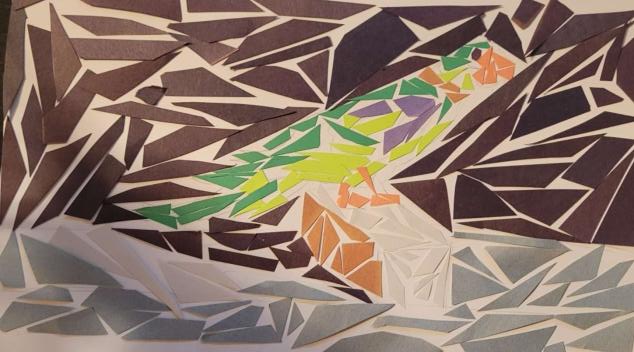
Transcript: Hello, I am Nikolas Posavec and what I have created is an imitation of the mosaic named “The Parrot Pergamon” by using everyday materials. More specifically, I used: colored paper, scissors, a pencil, and a pen. These seem like very simple things, as they are, but I feel I was truly able to capture the appearance of the original mosaic whilst still adding a twist to it. Originally I was simply going to recreate the mosaic using everything from the original, even the arrangement of tiles. However, after trying this I decided I wanted to use a style more appealing to me which is the more jagged, bigger pieces. The purpose of this work is to be a direct contrast to the style of the original while still maintaining the parrot’s image. My work is meant to represent how art can be manipulated into different styles without the meaning being obscured. An example of this meaning not being obscured in the new style I did was how I still used dull colors around the parrot to highlight it. This is important symbolically as it is inferring that the parrot is the light of life and color surrounded by this dark, plain background. This isolation allows the viewer to fully focus on the parrot and really appreciate it. One artist that inspired me in the creation of my mosaic was Volodymyr Yagodka. Specifically, in his work, “Woman in Red” as he had the red woman in the center very vibrant and surrounded by dull colors. This is similar to what I attempted to do by utilizing dull colors which was to draw attention to the centerpiece.
Volodymyr’s Work: https://www.saatchiart.com/cherrymosaic
Audio Clip: https://www.youtube.com/watch?v=tbodhmmqa-g
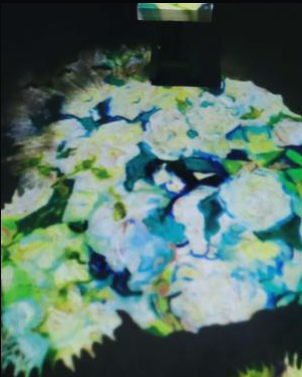
The audio clip I have chosen is somewhat simplistic, yet is still able to capture everything I need it to. I want the viewers of my piece to be more immersed in the work and this clip provides noises of the habitat the parrot would most likely be in. This enhances the natural effect and gives the viewers an opportunity to picture themselves in a rainforest observing a parrot peacefully resting while singing a song to them. The inclusion of this sound will also draw more attention to the centerpiece of the mosaic, the parrot, as the noises are similar to the ones a parrot would make. As I previously mentioned this focus on the parrot in the middle is one of my main goals. This audio clip will hopefully allow my viewers to have an immersive experience somewhat like the one at the Van Gough interactive exhibit. This picture I took is of a splash of paint that looks similar to a bouquet of flowers. While this image was being projected there was calming music allowing me to be more peaceful and fully admire the beauty of the flowers blooming on the floor. I hope to achieve this type of immersion so that my viewers can experience my work’s true meaning and artistic value.
Discussion Questions:
- Personally, I prefer the jagged shapes I used over the small squares originally used. However, which do you prefer and why? Do you think that the style I used detracts or adds to the original meaning?
- Did you find the audio clip I provided to be actually useful in making the work more immersive? If not what audio do you think would make it more immersive?
- What were the motivating factors in your composition? Was it for accuracy? Convenience? To challenge yourself artistically?
-
Subscribe
Subscribed
Have a WordPress.com account? Log in now.

