Audio can be used to accentuate vision, giving more depth and symbolism to what we see. This song, Busy – Grenn, accomplishes that with mere effortlessness. The song has a chill sound to it, using a very happy, vibrant, and major chord progression in a piano-like dynamic that can spark tranquility and joy in anyone who views it. The audio, when put next to my mosaic, can reinforce my artist statement through how the calmness and sentimentality of the song can bring the viewer back to a childlike time, one where productivity was not nearly as important, not as much as exploration of a new world was to a child before it enters a more mature state. The calm and vibrant feel made by the combination of this song and my mosaic were inspired by the Van Gogh Immersive Exhibit. A mosaic was projected on the floor, one with usage of very bright and joyful colors that tie in to this jubilant and recollective theme, one that could bring people to a smile as they remind themselves of the pure joy they once felt when they were younger.
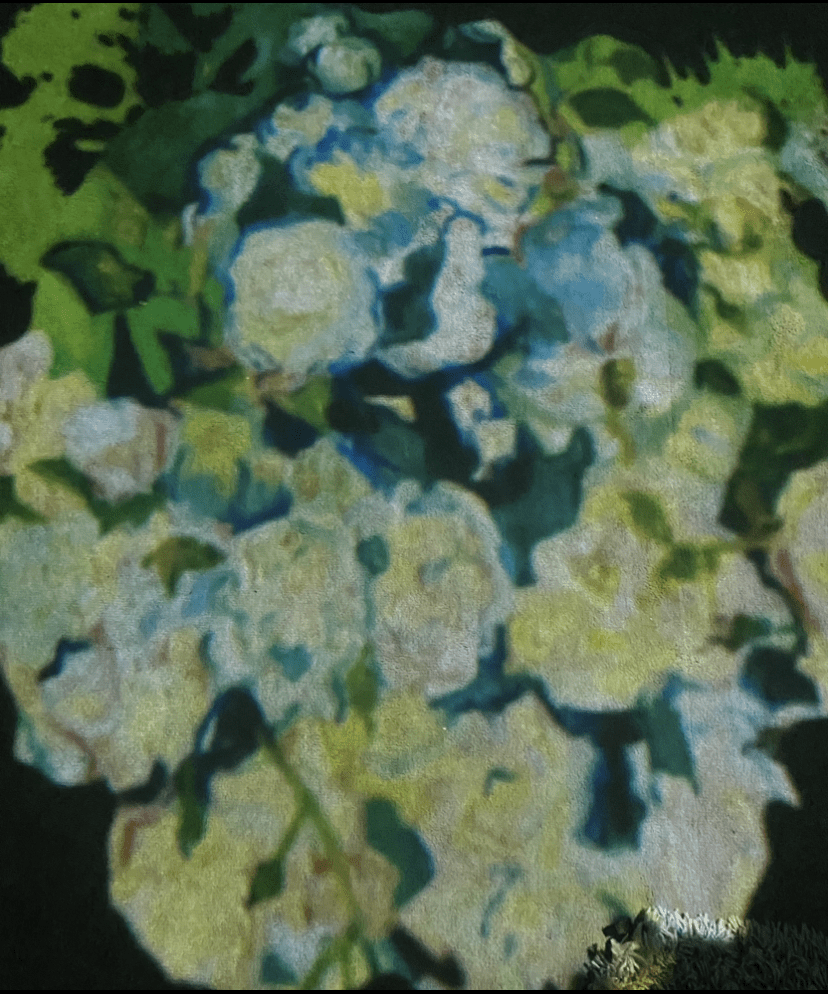
A photo of a projected mosaic of the floor of a scene in the Van Gogh Immersive Experience.
Some questions I had for other participants:
– Did the trip to the Van Gogh Immersive Experience give you any ideas for the creation of your mosaic? – Were you guys familiar with your song and knew that it would fit your theme? Or did you try to discover something new? – I found the work of creating my mosaic to be rather peaceful and enjoyable, how did you feel while making yours?
Above is a short piano piece that has a soft sound and does not distract from the art while looking at it. In fact, I would argue that softly playing music while looking at an art piece would help analyze the piece, as someone may be able to relate the music to the piece directly in a way like style. Similarly to how art museums have low, soft background music to keep a calming sense present throughout the museum’s exhibits, I chose this piece of music because it does not have any kind of unnerving or unexpected tones. I believe that having some sort of music playing while looking at and experiencing works of art is necessary to fully embrace the piece of art. Of course, the music should vary depending on what is depicted in the piece, but for the Parrot Pergamon mosaic it is necessary for a calmer sounding piece to be playing in the background.
Above is a picture of a mosaic projected on the floor at the Van Gogh Immersive Experience in DC. Similarly to how I suggested a calming music piece as linked above, the music being played during while this mosaic was projected on the ground was calming and softer. This mosaic is significantly better than mine as I am not an artist, but I’d like to think that mine is somewhat close to as cool in comparison.
Questions I Have/Had:
Which step of the process did you find most difficult? Which part was easiest?
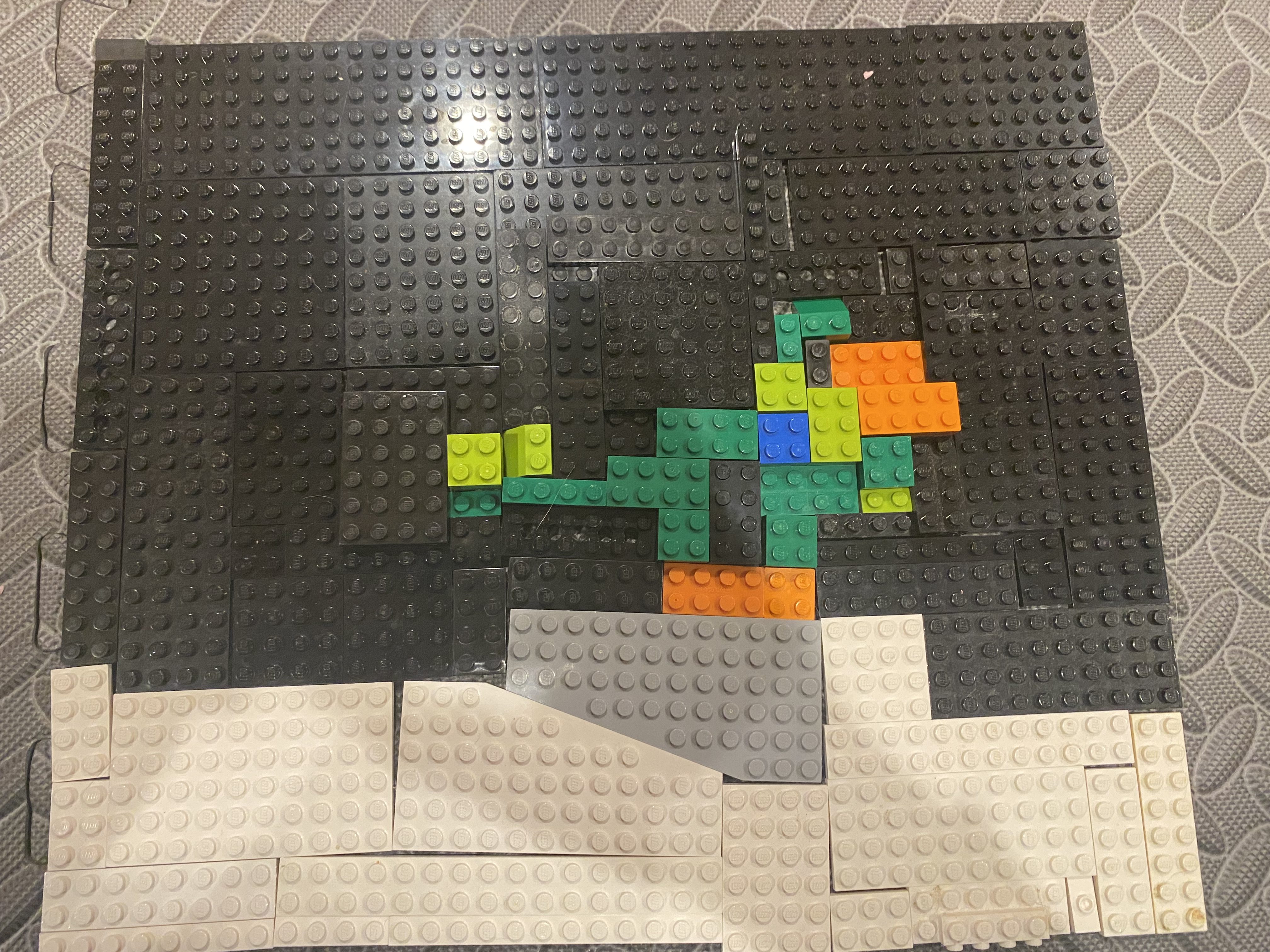
Seeing how long and frustrating it was for me to make a very small mosaic, how much of a daunting task would it for mosaicists to create a mosaic they weren’t enjoying making on a large scale, say if they were commissioned to do so?
Would it be easier and quicker to use materials with a greater height, like a thick tile, rather than a shorter height, like some of the Lego bricks I used?
(Building off question 3) Would using a taller material make the mosaic gain or lose the mosaic feel?
My desire to re-create the mosaic at Ostia Antica stems from my deep rooted love of the sea. Just like the ancient inhabitants of Ostia Antica, I love the ocean, though I do not make my living off of it as they did. The sea has always fascinated me, for many a reason, but what has always awed me more than any other aspect is the beautiful forms that life takes beneath the waves. The narrow, sleek forms of fish, the angular fins of sharks, and the strange tentacles of octopuses are all gorgeous shapes, especially fascinating because they seem so alien, so different from the fauna of the land. Perhaps this is why, when planning the materials for my mosaic, I chose to focus on capturing the elegant shapes of the original mosaic, which depict the gorgeous forms of aquatic life. For this reason I chose to use paint as my primary medium for the recreation, which allowed for accurate line work.
This piece includes many nautical themes, which can be further expounded upon to represent a theme of the fear of the unknown. The mosaic depicted many fearsome creatures of the deep, a threatening image for an ocean-based culture. Such a culture must have an extreme fear of the deep- the unknown that constantly lurks beneath the hulls of the boats upon which they rely. For the Greeks especially, death at sea was horrifying, as you could not cross the river Styx having done so. Because of this, the images are physical incarnations of these fears, the terrors of the deep unknown.
Clearly, the greatest influence for the Ostia Antica mosaic was the ocean itself. As mentioned before, the detailed shapes match the uniqueness of the ocean, but so does the entire chaotic yet beautiful composition.
This video is important for experiencing the recreation of the Ostia Antica mosaic because it creates a fully immersive environment for the viewer of the piece. Because the mosaic I chose is rooted in nature, featuring many impressive creatures of the sea, it is best experienced when the view feels as though placed in an environment with these creatures. This clip, which features the soothing noises of the ocean waves against a dock and the calls of seabirds, does just that, anchoring the viewer in a realm along with the figures depicted in the mural.
Further, this audio connects the viewer to the ancient artist who created the mosaic. The artist lived in Ostia Antica, and lively heard noises very similar to every single day, including those which gave them inspiration for the mosaic. I feel that feeling this connection, between the modern and ancient, also helps the viewer experience the piece’s theming. By being immersed in this ancient world, it is far easier to imagine the terror of the ocean’s depths; and the joy felt when the tides are fair.
Discussion Questions:
Examine the various creatures depicted. Which one jumps out to you? Explain the possible significance of that creature in both the context of the modern day and of the ancient world.
Do you believe the black and white coloring of the mosaic helps or hurts the piece? Why?
If you lived in ancient Ostia Antica and believed in their nautical pantheon, would you have loved the Gods or hated them? Would you have feared them or praised them? Could you do both? Why or why not?
Photo of final work:
Van Gogh Tie-in:
At the Van Gogh exhibit, I took a picture of what I found to be the most fascinating portion of the presentation: the fascinating shifting of gothic arches steeped in shadow, lit by flashing white street lamps. In this sequence, a dark series of gothic arches were backlit by flashing white lights, creating an almost strobe light like effect. This sequence was fascinating, beautiful in its simplistic design, making me feel both unnerved and awed with so few elements. In many ways, this is similar to the Ostia Antica mosaic. Both, though only consisting of white and black colors and fairly simple designs, are very evocative, and, I would argue, demonstrate exceptional design prowess. It is this simplicity, through which much demonstrated, that connects these two pieces.
(Apologies for poor quality-the projection was always moving, which made all of my imagaes blurry.)
The replication of the parrot depicted in the Pergamon Hellenistic Mosaic was created by me, Evan Rodgers. This recreation was made with the intention of honoring the mosaics from the ancient world and to gain a better appreciation for the process of creating a mosaic. I used construction paper, as there was an abundance on hand, and it was a medium that I was familiar with. The purpose of my work was to recreate a mosaic from ancient times in order to better understand the process of creating these specific types of art. The main idea expressed in my work is the heavy emphasis of the ancient world’s traditions being recreated in modern times with simple materials. The colors of the parrot in the reproduction are accurate to the real-world markings of actual parrots; however, they also have a specific effect on the viewer, with, for example, yellow representing happiness. The remaking of the mosaic was evidently strongly influenced by the original Pergamon Hellenistic Mosaic.
Audio ClipThe Final Draft of the Mosaic
The audio clip that I chose, “The Bard of Armagh,” from the album Celtic Mist, incorporates specific sounds of nature, including the chirping of birds, and the rushing water of a majestic waterfall. These elements, along with the calming arrangement of the musical notes in the piece, evoke a sense of well-being and tranquility in the listener, not unlike what one might experience on a warm spring afternoon. When paired with the color selection that I previously described in the mosaic, this dual sensory experience of sight and sound leaves a lasting impression of serenity for the viewer and listener.
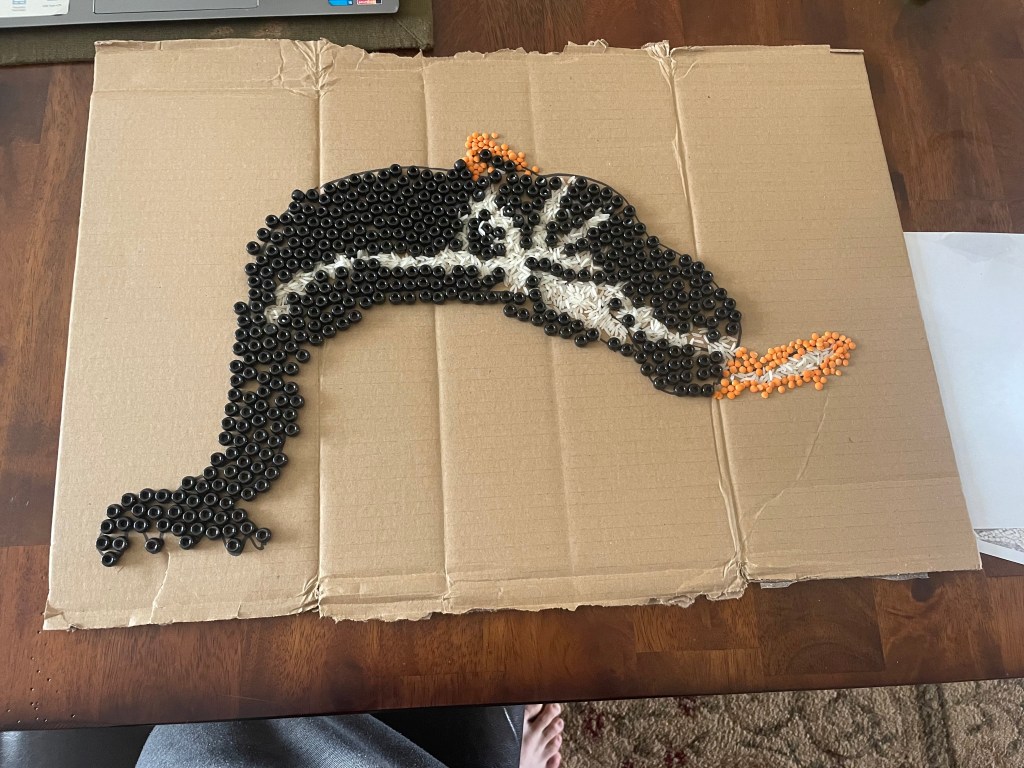
My mosaic of choice was the Dolphin from the Delos House of Dolphins. I am not much of an artist; however, this is my best effort as a recreation. This overall process took me about a month to complete, and my other posts on this blog display the steps I took. My purpose for this was to recreate an ancient mosaic and at the same honor the original work which can still be found today on an island which is part of Greece. This work also has symbolism. On the original design there contains a trident as well as the dolphin, this is used to honor the God Poseidon. The materials that I chose to use were as follows, black pony beads, used for the main body of the dolphin, white rice, to fill in the rest of the body, and red lentils, which I used to border the nose as well as the fin. Over the creation process not everything went according to plan, but I did my best and got it done, and I am happy with my work.
My Finished Product
My Audio Clip
This choice relates to my mosaic in two ways. First of all, my mosaic is of dolphins, and this song uses ocean noises, a pretty obvious connection there. This wasn’t the only song of this genre I listened to, but due to its obvious connection this is the one I chose to link. The main reason I chose this was because its slow, calming nature. Through this process I used Lo-fi music, such as this song, to help calm me down and get me through the project. Specifically, I listened to Lo-fi most while doing the actual creation of the mosaic. It calmed me down, which due to my decision to “risk it”, or not glue any materials down, was necessary to keep my hands steady so there were no mistakes. Overall, Lo-fi music, such as this, greatly aided in calming me down and allowed for me to complete this project.
Guiding Questions:
I personally had to adapt while creating my mosaic, did anyone have similar experiences?
For me the creation was by far the hardest part of this project, do you all agree with that or disagree? And why do you say that?
I know after this first attempt at creating a mosaic there is stuff I would do differently if I was to do it again, would anyone else, and if so what?
How did audio effect your project as a whole? Building off of that, were there certain parts you used audio more than others?
What do you guys’ think is the best material to use for mosaics?
My Image of the Floor from the Van Gough Experience
During the process of creating my mosaic I took a field trip to a Van Gogh immersive experience in D.C. On this trip I took a picture which was part of a projected display. This image relates to my mosaic in the clear lines being used to delineate shape. Specifically, this can be seen in the orange picture of Van Gogh. The clear lines create a much better shape and in turn create a much better image. In my mosaic, I traced first and followed those lines to create a clear shape that closely mimics the original mosaic and in my personal opinion (again I’m not an artist) this use of lines helped my mosaic come out, well, somewhat well.
My mosaic was a reinterpretation of a famous Ostia Antica mosaic, which can be found in Ostia, Italy. I recreated this mosaic using pony beads, which are white and black. The process actually took an extensive period of time, elapsing to over two hours of work. This was purposed to recreate and honor an ancient mosaic. It shows a recreation of a floor mosaic found in the ruins of Ostia Antica. It depicts two different boats and, what seems to be, a pot with fire coming out of it. I believe this was created in the first place to show important figures in the society. The boats were most likely made due to the fact that Ostia is found very close to the coast of Italy and served as a port city. In conclusion, this project was an interesting change from the traditional schoolwork style of just spitting out information. I enjoyed actually doing a hands on project that required me to get creative.
This song relates to my mosaic because it directly relates to my mosaic. My mosaic was created and presides in the Rome area. Throughout the song, it talks about Roman Cavalry and some of the lands Rome ruled over, such as Jerusalem. Also, it talks about the martial side of the Empire, speaking of swords and shields as well. Another way it relates to Rome is that it talks about missionaries and Saint Peter, which is the religious part of the Empire. In addition, I listened to this song a little while making my mosaic to help concentrate and stay focused, helping me get through the process of recreation.
This floor mosaic from the Van Gogh Museum because they both focus on colors. I tried to focus mainly on having accurate colors compared to the original. This mosaic shows vibrant colors, as well as mine. They had to make the mosaic move because if it stood still, it would look way worse than mine. My recreation was way better looking than any of the floor mosaics in this museum.
Guiding Questions:
What was the best part about recreating your mosaic?
What is an aspect of your mosaic that you would change or do differently now that you’ve finished the project?
In what ways can music help an audience interpret or focus on a certain aspect of a mosaic?
This piece of music really resonates with me because of the style of music and the simple but important name given to the song. I’m being really honest here, lofi/instrumental jazz music got me through this project. I have probably listened to at least ten hours of this style of music while I’ve worked to finish this embroidery piece. I love how the music simply flows with great beats to calm your mind but also kind of bleed out the outside noise, so you can work on your project. Also, the title Calm is exactly what I needed to be when toiling over my project. If I wasn’t calm, chaos would ensue like pricking myself with my needle or stitching into the hole outside the piece leading to twenty to thirty minutes of me trying to undo these stitches I made. All in all, this ambient music piece fits perfectly into the stitching world I lived in for the past couple of weeks, and thanks to lofi hip-hop music for staying with me while I loved and struggled through this project.
Guiding Questions for Discussion:
When people focus on different aspects of a mosaic, how does the point of view of an audience change from piece to piece?
Is using a square tile the best way to portray a mosaic or are more unorthodox shapes the better strategy?
Were certain aspects of a mosaic better to replicate since they are easier to connect between the original and the replication?
In what ways can audio/music change an author’s perspective on the piece they have just constructed?
Above is a photo of the floor from the Vincent Van Gogh Art Experience in Washington D.C. Even though there is a lot of simplicity in this photo (only having raindrops as a focal point), it ties in perfectly with the theme of the mosaic I created. My personal goal was to contrast foreground and background in my stitchery to the point where you could enjoy both separately while also enjoying the whole composition. That idea applies to the short time the raindrops were simulated on the floor because the two were so sharply different you could take in both or either one by itself and enjoy its simplicity. Another small continuity between this photo of a floor and my mosaic is the use of circles. Both compositions make use of a bordered outline (farthest circle) and then place the rest of the piece inside of that bordered outline. I find this as a really interesting similarity because it allows each bubble on the floor to shine individually while also being a cohesive set, and my mosaic can also have its own individuality when placed with all the Parrot Pergamom recreations.
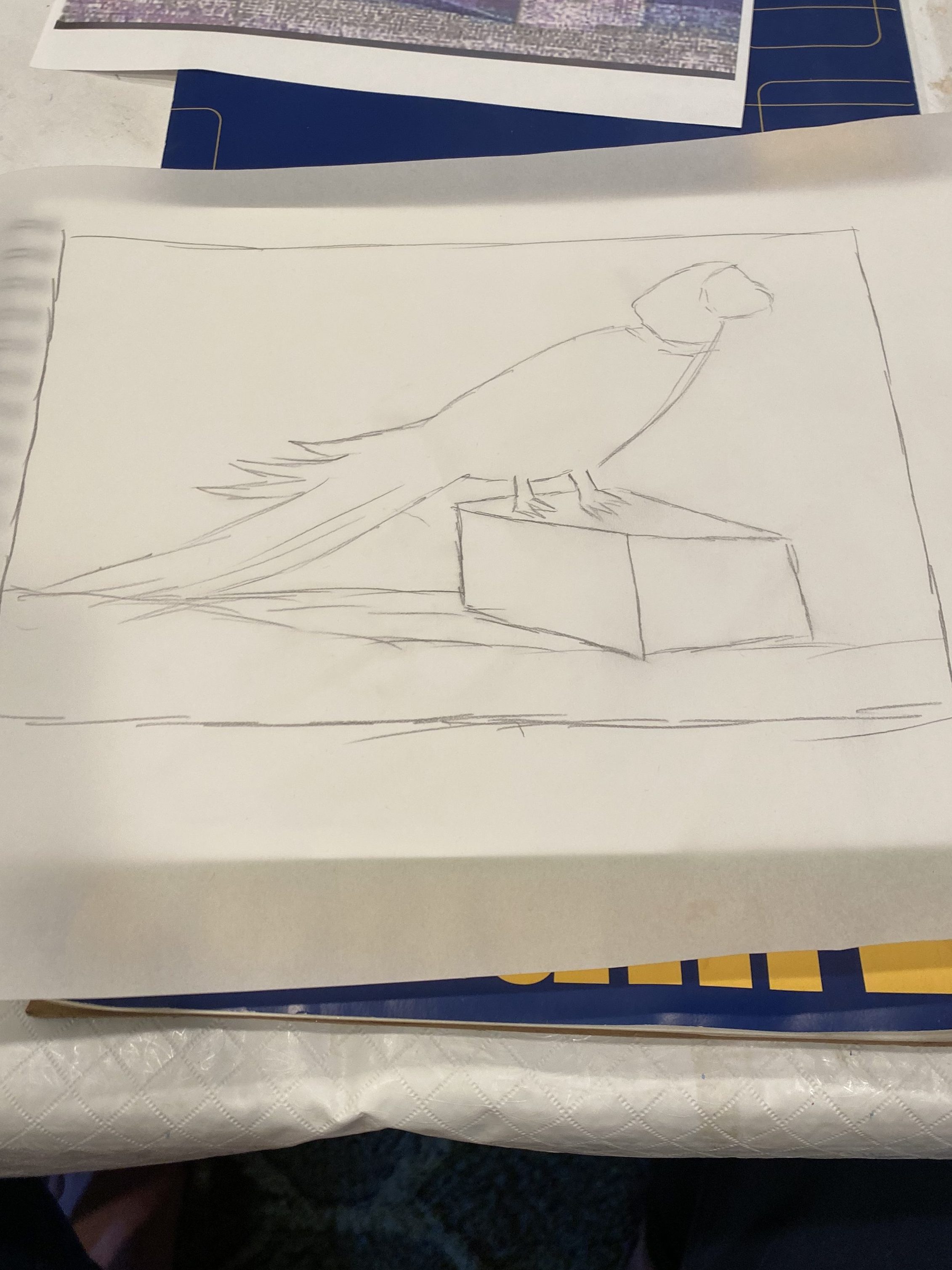
I started my recreation of the Parrot Pergoman mosaic by printing out a picture of it and tracing it. I used thin paper so I could see the lines of the actual mosaic through it. This section was vital as it is was the foundation of the entire mosaic, but it was not challenging because I simply traced the lines that were already there. After I finished tracing, I got out the materials for painting but noticed I did not have that many colors and I wasn’t sure how to mix the colors to create the ones I wanted. I decided to switch from the original idea of painting to using colored pencils as I have a lot of them and I am more experienced using them. This made the process much easier than it could have been because painting was the only part I was not confident about. I used the colors I had and layered them to replicate the colors of the actual mosaic. Once I finished coloring, I cut the mosaic into strips but left the ends attached so the paper was in one piece. I left it in one piece so it would be easier for me to place the pieces in the right places without them getting too mixed up. I cut across the strips making tiny squares and glued them onto the paper. This was a tedious process because when I cut the pieces, they would fly off in different directions and get out of order. I used a glue stick to make lines across each section and slid the squares onto their correct spots. The glue stick worked very well because it allowed me to easily make lines of glue across the page for my tiles. Some tiles got mixed up in the process which made it confusing but it ultimately worked out in the end.
Recreating this Parrot Pergamon Mosaic was more tiring than I originally thought. I almost completely changed my plan on making this mosaic. Firstly, I chose to work on my mosaic on the kitchen table for light and more space instead of in the dark and cold basement. I got my crayons and laid them out onto the table and sorted out the colors. I picked the best colors that I thought looked similar to the colors on the original mosaic. That was the easiest part of this project. After I was happy with the colors I chose, I had to peel off every single wrapper for over 50 crayons so that there wouldn’t be any paper on the mosaic. That really took a lot of time and made me frustrated. After peeling off the paper, I cut each crayon into little pieces and placed them into mini containers. Cutting the crayons into mini pieces made it look like the tiles on the original mosaic. Afterwards, I got my black canvas and sketched out the bird with a pencil so I can outline where to put the little crayon pieces. Instead of using these crayons to melt them down onto the canvas, I just chose to glue the little pieces onto it. Melting would be much harder and be way messier. It was hard choosing what to do with these crayons since there were a lot of possibilities. I poured the glue into a little container first. Then, I dipped a chopstick in it and put little spots of glue onto the canvas. I then put the little pieces of crayons on the canvas and they stuck pretty well. Some crayon pieces weren’t cooperative, so I had to use a lighter to slightly melt them so that they would stick better. So far, recreating this mosaic is going pretty well. I have attached a video/photo montage of my work in progress.
My Parrot Pergamon Mosaic Recreation Photo Montage
As I began working on my mosaic, all was well. I got my paper cut out, with plenty to spare; and drew the outline of the piece of the mosaic I was recreating. This part turned out to be quite easy, and only took me about five minutes, but this could simply be due to my exceeding artistic prowess. However, I noticed something was awry almost immediately. The one square inch pieces of paper I cut out would be too big to fit my mosaic properly. This was an easy fix, though, as all I had to do was cut them according to the space they were to fill. This proved to be more irksome than I thought, and it ended up taking me much more time than I anticipated. For the next part, I think I will just spread glue in the places I have determined will be black, and just drop my pieces of paper on those spots. After, I should be able to just shake the paper out, letting the excess fall off if they aren’t glued. Following this step, I am mostly finished, however I do predict that touch ups and other small details will need to be tended to.
1 square inch pieces of paper I cut out
29 October 2022
I have lost the bag of paper clippings I cut out a few days ago. I still have my outline, thank goodness, because I would rather not have to redraw the whole thing (I’m very proud of the work of I did on that). I just really hope I can find that bag before too long.
31 October 2022
I have recovered the pack of paper. My father put it in a cabinet without telling me, but I can now finally continue on my project. I began to glue, but it dried before I could place the paper where I wanted. I decided to just do sections at a time until I was finished, which worked perfectly. I have completed my project, but you must wait until the next post to see the finished result.









 MOSAIC PROJECT 23