-
Delos Dolphin: The Research Behind It
Ben Cuomo

This dolphin I have selected to recreate is a mosaic from Ancient Greece. It is believed to have been created in the late second century/early first century BC. Meaning that this mosaic, and other mosaics found in Delos are over 2100 years old. Due to warfare, mosaics such as this one, also known as Hellenistic mosaics (Hellenistic meaning relating to Greek culture, history, and/or language from the death of Alexander the Great until the defeat of Cleopatra and Mark Antony) stopped being created in around 69 BC. The materials used to make this mosaic were colored tesserae and well as white and black pebbles.
As I previously stated this mosaic and many similar to this can be found in Greece. Specifically, Delos, Greece. Delos is an island near to the center of Cyclades, which are an island group in the Aegan Sea. This area is found southeast of the mainland of Greece and is a former prefecture of Greece. This area of Greece contains a very high percentage of surviving mosaics from the Hellenistic period, containing just about half that remain. Some examples of other mosaics from this time period, in this area, are mosaics from the House of Dionysos. The reason all these mosaics could be found in Delos is largely due to the city’s importance during this time. Delos was one of the most sacred places in ancient Greece as well as one of the largest trade hubs. Its location was very advantageous for trade, being a middle area between the major commercial areas on the Aegan such as Athens, Corinth, Macedonia, etc.
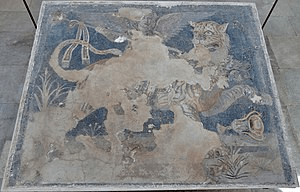
Dionysus Riding a Tiger The picture of the dolphin I selected is from a larger design, The House of Dolphins. The whole mosaic, including the part I will be recreating, was created by Asclepiades of Arados. We believe he was the artist who designed this mosaic because it is his signature that can be seen on the mosaic. This mosaic is unusual for the area and time, and that’s because Asclepiades had the mosaic follow a peristyle floor mosaic design pattern. Peristyle meaning “a row of columns surrounding a space within a building such as a court or internal garden or edging a veranda or porch”. In other words, the design of this “House of Dolphins” is that of having a row of columns on the outside surrounding the mosaic which is on the floor. This specific mosaic has a circle on the floor which is enclosed by a square outline. Each corner of this square has two dolphins which are being ridden by tiny, winged figures who have emblems of various Greek deities on them. The specific emblems are thyrsus (a wand or staff of giant fennel which is covered with ivy vines and leaves), caduceus (a symbol of Hermes, a staff entwined by 2 snakes surrounded by wings), a trident (a fishing device that is the tool of Poseidon, the God of the Sea), and then one other object that unfortunately has been lost to us due to damage. The circle also contains a central rosette design which is surrounded by floral garlands (a decorative wreath of flowers) and griffins (legendary creature with the body, tail, and back legs of a lion; the head and wings of an eagle, and sometimes the eagles’ talons as well).

“The House of Dolphins” in its current state This mosaic was probably made for various reasons. One is that it was to express our creators’ artistic abilities while honoring Gods and other mythological creatures from that time. My reasoning for that is that there are emblems of different Gods which I previously explained as well as Gryphons who are a mythological creature. Two other possible reason ties into its state of being in Delos. The first of which could be due to beliefs of the time. These mosaics were created on the floor for all to see and to be statements of beliefs. These beliefs could be unifying forces to help contribute to a stronger national identity in the area. The second possible reason relates to Delos being such a large trading area. Being such a large trade hub definitely leads to wealth, and mosaics, such as the one I have chosen, can be used as status symbols. In other words, the mosaic was used to show off the wealth of the area.
Overall, from my research we can tell the style of design it follows, who made it, and that he definitely respected the Gods. Based on the location we can also assume when it was made and also why it was made.
/https://www.youtube.com/watch?v=U-zTvebQ6gItch?v=U-zTvebQ6gI
From approximately 7:08-7:25 the mosaic and “house “as a whole can be seen in greater detail.
Sources Used:
This article gives information about the specific Mosaics, time periods, and information like that: https://www.romeartlover.it/Delo2.html
This article is an informational article about Delos which gives historical, mythological, and Architectual information about the area: https://www.worldhistory.org/delos/delos/
This provides some specific details as well as more general information about the mosaic : https://en.wikipedia.org/wiki/Mosaics_of_Delos
As well as https://www.dictionary.com/ for specific definitions
-
Parrot Pergamon: A Research Narrative
TJ Barczak
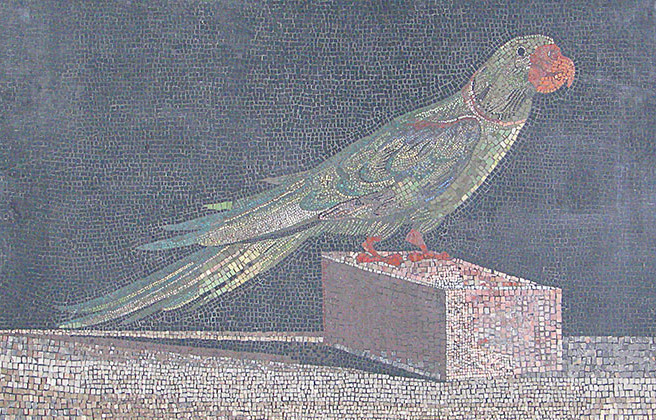
Original Mosaic “Parrot Pergamon” – Source: Wikimedia Commons Parrot Pergamon is designed after an Alexandrine parakeet or parrot. This bird’s name comes from Alexander the Great; he created a large empire that stretched across Eurasia from Greece to India. Designed a made-in Pergamon (modern-day Turkey), an artist completed the mosaic around the middle of the second century BC, during the reigns of Eumenes II and Attalus II. This mosaic is from a floor panel in the “altar room” of the Pergamon Acropolis in Palace V; the mosaic was discovered in an excavation led by archaeologists Richard Bohn in 1996, where his team excavated this piece of art along with tons of other mosaics across the acropolis. Today, the Pergamon museum owns and displays it in Berlin, Germany.
A mosaic is a design or image created with small pieces (tesserae-i) of materials to decorate floors, walls, or ceilings. The Parrot Pergamon mosaic was created using opus vermiculatum; this Greek method of artwork made rows of colored stone tesserae, so it imitates color painting. Opus vermiculatum means “worm-like work” and is supposedly one of the hardest and physically demanding styles of mosaic work. Borders were made of darker tesserae to brighten the focus of pieces usually made with more vibrant colors. Mosaics like the Parrot Pergamon only used artistic styles like color and tone to accentuate their subject. Another technique used in the mosaic was emblemata. This method was easily transportable; master artists could make a more detailed section of tiles to send out to the acropolis, where tiles can be placed into the more basic background and then touched up and fixed by assistants. Here is a short video to learn more about this style of music building: https://www.youtube.com/watch?v=u0rDj-hOViM
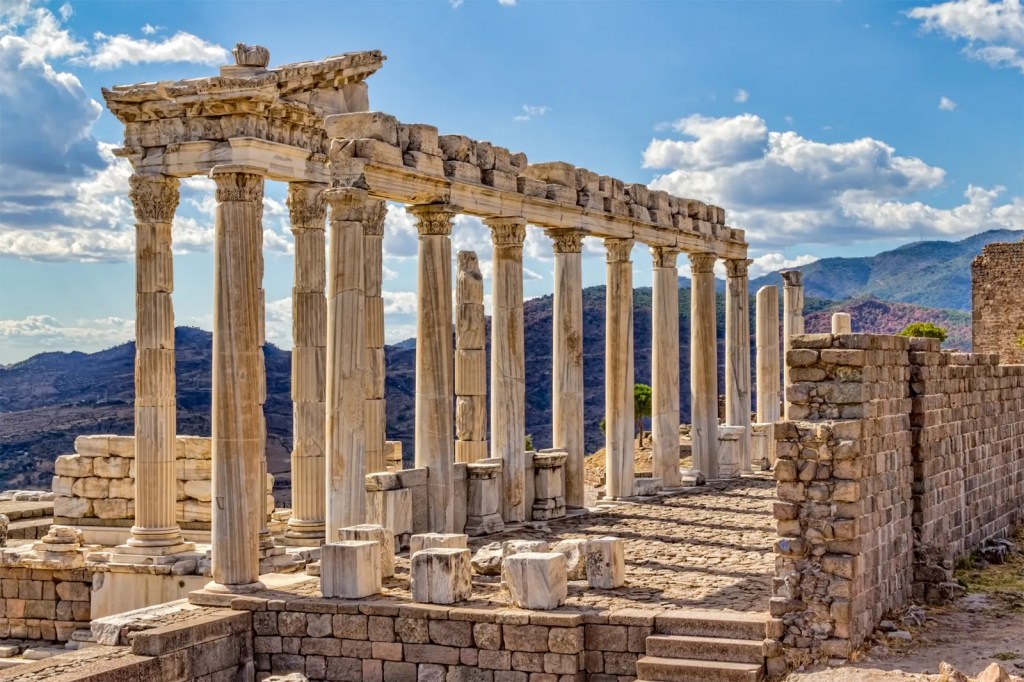
View of the Pergamon Acropolis – Source: Thrillophilla.com The city of Pergamon in the course of the reigns of both brothers Eumenes II and Attalus II prospered. The Library of Pergamon was established; it rivaled the Library of Alexandria due to its wide array of books. Pergamon became a cultural, political, and scientific center for the Mediterranean world with tons of literature, Greek architecture, and art across the empire. Throughout Pergamon’s vast history, it was a multicultural landscape between the Hellenistic Attalid dynasty and the Roman Empire annexed the city from the Attalids. The parrot mosaic would then have influences coming from Romanic and Hellenistic art styles seeing that both controlled the acropolis.
A detail lost to history about this mosaic is its author. There is no historical record of mosaic artists that created anything in the Pergamon Acropolis. The only piece of literature that mentions an artist was by Pliny the Elder, which wrote of Sosos, an artist who resides in Pergamon.
Moving back to the main subject of the Parrot Pergamon, the Alexandrine parakeet is a medium-sized parrot that Alexander the Great transported across the world. These birds went from the Punjab region in India to many regions of Europe and the Mediterranean coast. These birds were cherished by royals and nobility whenever and wherever the birds were received. The parrot in the mosaic also resembles the Alexandrine parakeet’s close relative, the rose-ringed parakeet, because of the bright red or rose ring around the neck of the bird.

Alexandrine Parakeet is situated on a branch looking outwards. – Source: Hagen Avicultural Research Institute Overall the research on the Parrot of Pergamon, conclusions can be made from the unknown details. All the techniques used in making the mosaic were kept through history but the lack of documentation on the artist leaves a tremendous detail out of the picture. But, both the city and the mosaic were specific examples of cultural syncretism between the Romans and the Greeks in their separate reigns of the city of Pergamon.
Works Cited:
-
Hello World!
Welcome to WordPress! This is your first post. Edit or delete it to take the first step in your blogging journey.
-
Subscribe
Subscribed
Have a WordPress.com account? Log in now.

