-
Ostia Antica
Origin and History of the Site
Ostia Antica was an ancient seaport built in 355 BCE, originally as a military outpost. It received much traffic due to vendors and adventurers passing through, and eventually became a large trading hub for the Romans. It grew in popularity and had many architectural delights created in the town. The Cart-Driver’s Bath and the Baths of Neptune are the most famous of those constructed. They have beautifully crafted mosaic floors that have beat the test of time and are still standing today. Besides the bath house tessellations, there were advertising mosaics in the Forum of the Guilds, a place where salesmen and merchants set up their shops and stores. Ostia Antica was also the site of battles during Roman civil wars, as cutting off its trade was imperative. Temples, warehouse, and even apartments were constructed for its some fifty thousand residents. However, all good things must come to an end, and eventually Ostia Antica became infested with malaria, causing it to be abandoned. After this, the city was subject to looters and thieves often, and much of what Ostia Antica had may be lost forever because of them.
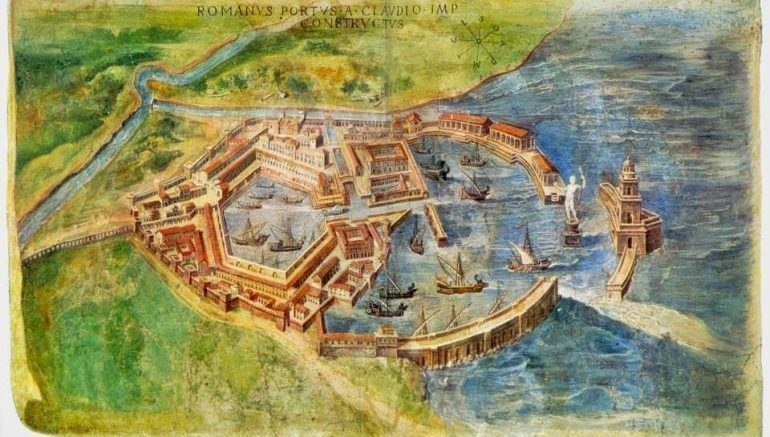
What Ostia Antica may have looked like; More Information on Ostia Antica The Baths of Neptune
The Baths of Neptune is the most distinguished and acclaimed mosaic of Ostia Antica. Nothing is truly known about the specific architect, builder, or artist of any of it. It was a bathhouse for wealthy Roman people who wanted to separate themselves from the common people. The mosaic was built around 139 CE and is made out of marble, flint, and local rocks. The entire thing is an enormous four thousand square meters. It depicts Neptune riding a chariot that is being pulled by hippocampi, or mythological seahorses. It also has images of fish and other aquatic animals. In one of the main bath chambers, the frigidarium, there is a depiction of Scylla, a legendary Greek and Roman monster of the seas. There are pictures of what appears to be boxers or fighters and even one of Amphitrite, Neptune’s wife, riding a hippocampus. Each of these mosaics are in different rooms and cells of this massive bathing house.

Neptune riding his chariot pulled by hippocampi. (Baths of Neptune) Why Mosaics?
Mosaics are a form of art in which many small stones, tiles, or other pieces are placed and colored to produce an image or scene. They have originated separately in places like Mesopotamia and the Americas, but the Romans and Greeks popularized it. The Romans used mosaics as ornamental walls, fountains, floors, etc. They were used as advertisements in cities, ways to celebrate religion, and overall expression of creativity and art. The main reason mosaics were used over paintings or other forms of art is because they would last longer, were often easier to make, and could be put literally anywhere. They could be put in places where there is water, unlike paintings, such as bath house or ports. This versatility is what made them so loved and famous, as efficiency is always favorable. Due to the nature of how they are made, mosaics can last an incredible extent of time, especially if covered by layers of dirt and clay, like most are after all these years.
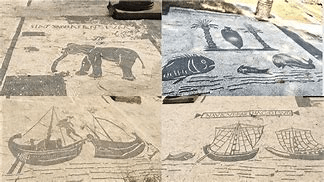
Ancient Advertising Mosaics of Ostia Antica Cites Used
Mules, Gods, and Ad Men: Ostia Antica’s Mosaics
History of Mosaics in a New Light
-Christopher Geldmacher
-
Parrot Pergamon Mosaic: Historical Analysis
By: Connor Bravo
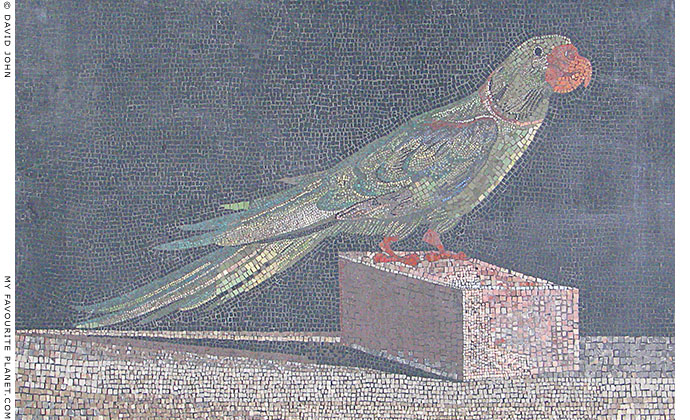
Alexandrine Parakeet The Pergamon Parakeet (Psittacula eupatria) is a stone mosaic made around the middle of the 2nd century BC. It was named the Alexandrine parakeet after Alexander the Great because of how he sent birds from Punjab to the west. The mosaic represents the parakeets and how they became exotic pets and symbols to noble families. This mosaic was a floor panel, which was part of a much larger picture, in a small altar room in Palace V of the Pergamon Acropolis (Turkey). This mosaic wasn’t found until many years later in June of 1886 by excavators led by Richard Bohn. To get the color and intricate design in this mosaic, the Greeks used a method called opus vermiculatum. This just means that colored tesserae were used to give this parrot some life and eye-catching color. Other things such as plants and mythical figures were made in this way, not just animals. Birds were especially popular such as the dove which usually symbolized love and peace.
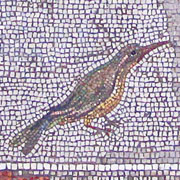
Bird from the same altar room and the parakeet. This was an important part of Greek culture and really showed how they made their art and techniques known to the world. Many of these mosaics are still admired, looked at today, and influence today’s art. Mosaics such as this parakeet are held in very ancient buildings. Many of these mosaics still haven’t been discovered today because they’ve been buried deep in the ground, have been destroyed, or haven’t been searched around for. The condition of the parakeet mosaic had deteriorated over time and lost many of its parts unfortunately. The remaining parts are being held in the Pergamon Museum in Germany. Finding the artists for these different mosaics can be difficult either because it was too difficult to see, there was no signature, or there were multiple people working on the same mosaic. In this parakeet mosaic, the artist isn’t completely known or agreed upon. Scholars think that the main artist was Hephaistion because of their signature on one of the corners. Other artists such as Sosos worked at Pergamon creating more art. There is a whole controversy about who actually worked on it. Maybe they even came together and worked on it together.

Signature in Greek writing left on the floor of the ancient palace. Mosaics were created in this period either to show off their art design and ideas, to decorate buildings such as palaces and churches, to worship higher deities, or to serve as protection from harsh weather. Some mosaics were also made to show status or honor to different families. There are still some mosaics being built today using the influence of Greek culture, but have died down recently either because of the loss of interest in the culture, the advanced technology being used to create art, or the influence of more pop culture art ideas.
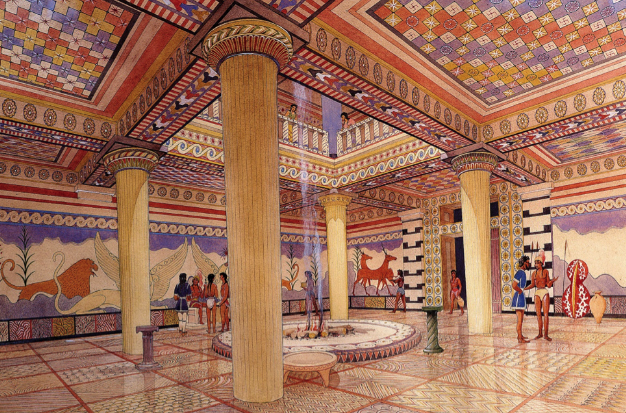
Palace of Nestor (Mycenaean Greece) There are many researches out there trying to analyze these different mosaics and see what they can interpret from them. There are even people traveling the world still trying to look for these hidden gems. Some are even over 2,000 years old! This is a video in which it shows very old, but detailed mosaics being discovered and looked at by excavators. Some people in this video also talk about the mosaics and what they think of them.
2:12 – Excavators Discover Mosaic in the Ground Sources
https://artsandculture.google.com/asset/parrot-mosaic-unknown/dAHr0Sez7P1WiA?hl=en
http://www.my-favourite-planet.de/english/middle-east/turkey/pergamon/pergamon-photos-02-012.html
-
The House of Dolphins
– Jack Geibler
The piece of art being presented is a series of small pieces being put together in order to make a larger piece of art. This is called a mosaic and it is from Delos depicting a dolphin wrapped around a trident. This mosaic was built around 100 B.C. right between the Hellenistic period and the roman period of Greece. This brings an eclectic approach showing the identities of both cultures in the mosaic. The mosaics in Delos have some of the most concentrations of artwork for the time period.
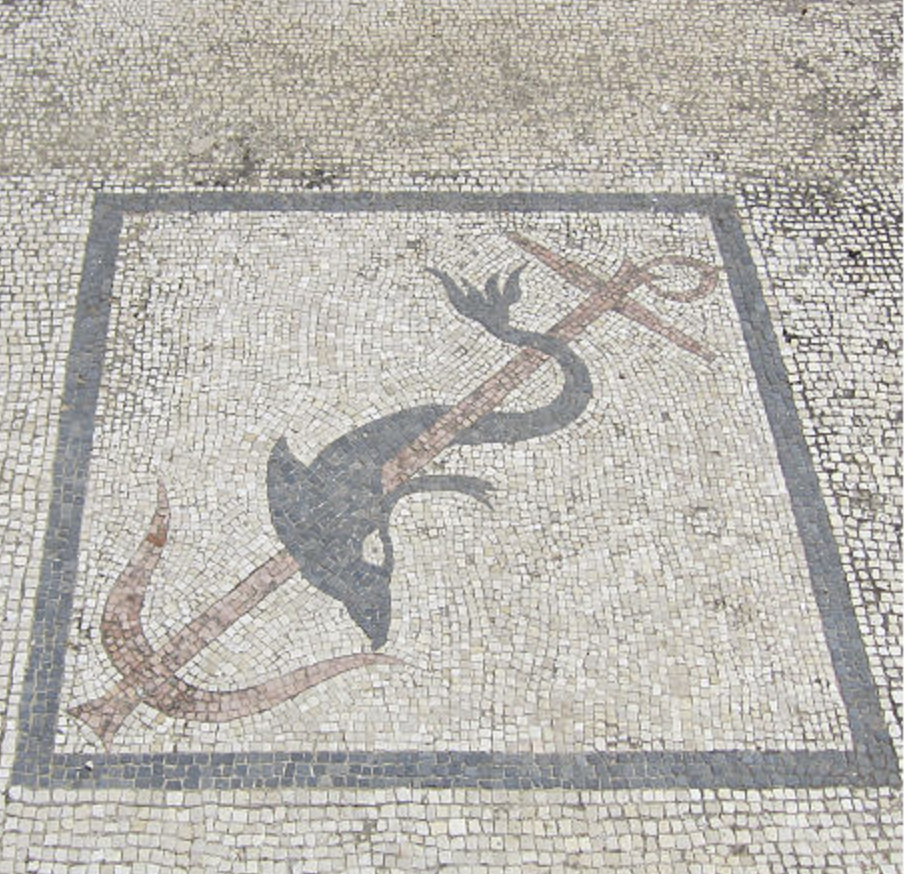
Why Dolphin and Trident?
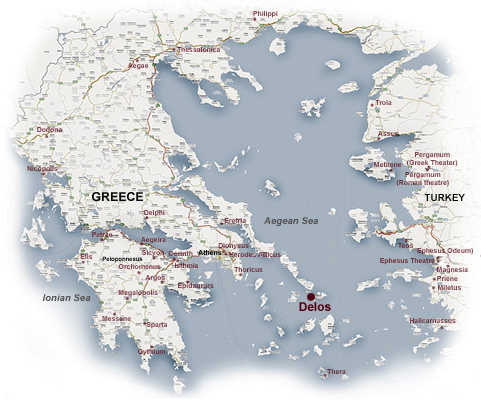
The mosaic is on the island of Delos which is a small island in the center of a large group of islands in the Aegean sea. Thus, it is a large trade port and has a lot of people crossing by. The only problem with that is the thread of other people trying to take over the not-so-powerful territory. Luckily, they had protection from Macedonia. That was important for the architecture, including the mosaics’ preservation. The mosaic depicts a Dolphin, which was a preferred subject for mosaics. The reason for this goes back to a story. A famous poet, by the name of Arion, was threatened with death because people were trying to steal his riches. As he is left to drown at sea, Apollo “the God of poetry” sends dolphins to save him. The dolphin saves him and brings him to the sanctuary of Poseidon. This story helps bring out care for dolphins in that society.
What was it made of?
This mosaic’s purpose was solely decoration. The design is peristyle which was unusual for the area. A peristyle is a space surrounded by pillars inside a building. Peristyle is an example of Greek architecture used with the mosaic. It is hard to find any purpose for the mosaic because there is not much known about the creator. The dolphin around a trident is a part of a circle of mosaics. Asclepiades is the creator of the piece but not much is known about him. The piece stayed alive because of its relevance in history. People wanted to keep it alive so that others can learn more about Delos and Hellenistic traditions and religious beliefs. This was a strong force for its protection over the large number of years that it has been preserved.

example of peristyle Where is this Mosaic?
This mosaic was on a small, rocky island called, Delos. Delos is a site where various old mosaics are. Once discovering these mosaics, the Delos restoration works made sure to preserve these works as best as they could. It could stay so well preserved before because it was uninhabited since 600 AD. Delos, at the time, was a major port used by many around the Mediterranean. Now, the entire island is used as an archeological site. The House of the Dolphins mosaic was made of tesserae, which is a small square piece of stone. Tesserae was a common material used for mosaics.
Why Mosaics?
Mosaics were used a lot for decoration in this time period. That begs the question, why were they making so many Mosaics. First of all, it helps show what life was like at the time. Mosaics would depict things that were going on that can show details about the culture of a certain area. Mosaics were used on floors. This is a form of art that isn’t used very often. The new idea of putting it on the floor would make itself stand out. Secondly, it represents status and wealth. People would have mosaics in their house so when a guest would come over, they would be impressed. Everyone is big on how others see them and their outside appearance. Lastly, they tell us about ancient history. For example, a mosaic might be a picture of a certain area in which people today can observe to learn more about the time period. This brings the culture of people from so long ago, back to life.
Finally here is a video showing the house of dolphins 0:00-0:12
Works cited
https://www.merriam-webster.com/dictionary/peristyle
https://ancient-greece.org/archaeology/delos.html
https://whc.unesco.org/en/list/530/
https://www.getty.edu/news/a-brief-introduction-to-roman-mosaics/
-
Parrot Pergamon – Art Made of Earth (Aaron Caddick)

The Parrot Pergamon was a mosaic made in Greece, around 200 B.C.E. The bird in focus of this mosaic was the Alexandrine parakeet, more scientifically noted as the Psittacula eupatria, which is a colorful avian that is seen from Afghanistan to Southern Asia. It has also been noted that the bird has developed an alien population in Europe, due to their popularity as pets.

An image of this Psittacula eupatria, perched on the sorts of a brick. my-favourite-planet.de/english/middle-east/turkey/pergamon/pergamon-photos-02-012.html As for the mosaic itself, it is currently housed in the Pergamon Museum, a museum dedicated to the keeping of various artifacts found in the city of Pergamon, located in Berlin. The piece was constructed through traditional means of mosaic creation. This methods include the usage of a variety of colorful stones (typically broke into smaller pieces; tesserae), which when found in the right color can allow for versatile usage in artistic depiction. Glass was also a valid and rather conventional means to replace the stones. As for the apparent, contrasting, filled gaps in between these stones, they were made from mortar paste. After the mortar was finished drying, the stones and piece as a whole would be polished for a benevolous finishing look. Though the Parrot Pergamon was of Roman origin, a lot of the traditional techniques of creation were associated with the Greeks.
These mosaics, instead of being used purely for art, were often used as flooring for various temples and buildings of high importance – such as temples and that of royalty for this particular mosaic. This is known due to the discovery of the Parrot Pergamon as apart of an altar floor of Palace V of the Pergamon Acropolis. As for what was shown on mosaics in general, it typically consisted of depictions of nature and animals, including but not limited too flowers, fruits, and in this case birds. A lot of the mosaics that were once present in the Palace V were now destroyed, but the ones remain describe a vivid idea of the construction of the art.

A person is shown here using a variety of colored tesserae for portrayal of a design. thesprucecrafts.com/mosaic-supplies-and-tools-1252818 A more in-depth guide of the creation of these mosaics can be viewed here:
The video shows a Chicago man creating a mosaic of a giraffe in his studio with an explanation of the process and work behind it. youtube.com/watch?v=fvX1vorZgF4 The video shows how specific materials and tools are used to create mosaics. It goes into great detail with all of the steps that occur when they are made. From the original sketching in marking certain areas, to the usage of certain stones to polish the finished product, and everything in between like the separation of rocks to form tesserae, this video shows how complex the art of the mosaic can get.
There was a reasoning behind the creation of the Pergamon Parakeet besides artistic depiction and flooring; it was also a tribute to Alexander the Great. It was believed that he was the one who spread these birds globally to wealthy families who kept the flying friends as exotic pets. This dispatch from Alexander was said to have originated from the Punjab where the birds were allegedly found. This is also the reasoning for its informal name of Alexandrine parakeet. The artist giving this tribute was unknown however, and there exists minimal information on who could have created the mosaic originally back in 200 B.C.E. This lack of information creates holes in the background of the mosaic, but historical context such as the location of discovery in Pergamon, and other relevant artists of the time such as Gnoseis and Hephaestion (known through the signing of their work), gives us an idea of the background of the beautiful creations we call mosaics.
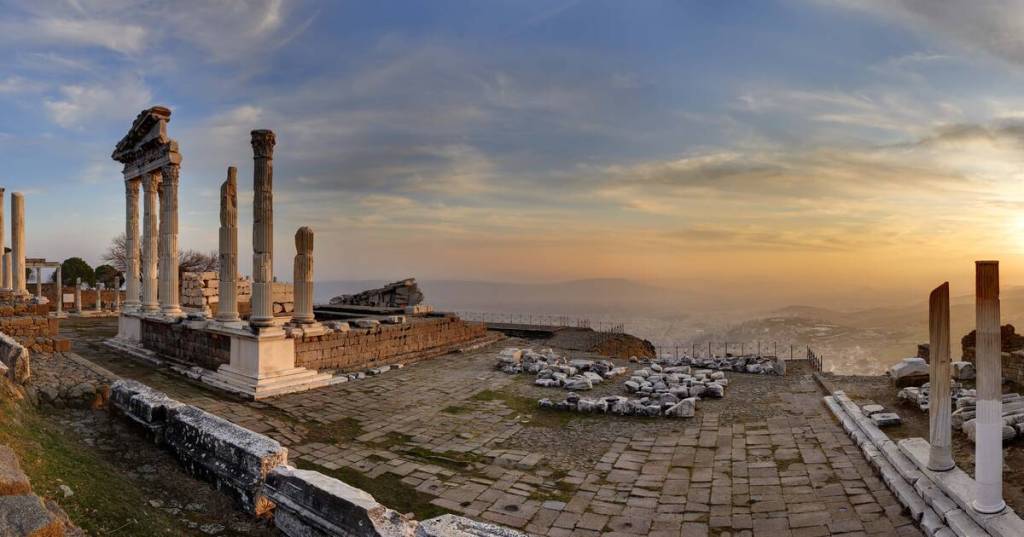
A photo of the remains of Pergamon. whc.unesco.org/en/list/1457/ Works Cited:
– www.cabi.org/isc/datasheet/18174936
– my-favourite-planet.de/english/middle-east/turkey/pergamon/pergamon-photos-02-012.html
– classicalwisdom.com/culture/a-guide-to-greek-mosaics/
– thesprucecrafts.com/mosaic-supplies-and-tools-1252818
– youtube.com/watch?v=fvX1vorZgF4
– whc.unesco.org/en/list/1457/ -
Alexandrine Parrot Mosaic Background Guide
By Vasilios Van de Verg
The Alexandrine Parrot The Alexandrine Parrot Mosaic is a stone mosaic made sometime between 160 and 150 B.C.E. It is one section of a mosaic that once covered the floor of the altar room in Palace V of the Pergamon Acropolis. Pergamon was an ancient Greek city located just outside the modern Turkish town of Bergama. The palace that it was found in was used for official business by the king of Pergamon and was adjacent to both the king’s private residence and the Temple of Trajan. The altar room where the Parrot was found was used for religious ceremonies and sacrifices. This room would be doubly important because it was not only a place of worship, but also as a room in the king’s official building. But why is a mosaic of a parrot in such a significant place? Mosaics were often used as displays of prosperity. The Alexandrine parrot is native to India, and Alexander the Great is said to have sent some specimens to the Mediterranean, where they became a popular pet for noble families. Having the resources to commission a mosaic was a sign of wealth, but to have a mosaic of one of these birds in the palace implied great richness.
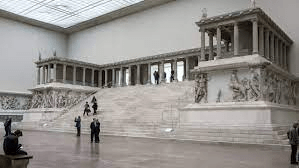
Recreation of The Altar in The Pergamon Museum Similar mosaics were usually made in sections by multiple craftsmen and then assembled on site. There is another section of Palace V’s floor where a mosaic of a piece of parchment that has “ΗΦΑΙΣΤΙΩΝ ΕΠΟΙΕΙ” or “HEPHAISTION MADE IT” written on it lays. Hephastion may have been one of the craftsmen who worked on the Parrot. It may have also been made, in part, by an artist named Sosos, who is mentioned in the writing Pliny the Elder, and who worked at Pergamon.
The Alexandrine Parrot is a kind of mosaic called “opus vermiculatum”, which is Latin for worm-like work. The technique was developed by the Ancient Greeks and the earliest known example was dated to around 200 B.C. Mosaics of this style are made of curved lines of many small colored tiles, hence the title of ‘worm-like’. The use of small tiles allowed for color gradients and the lines of color give a similar visual effect as does strokes of paint. Individual figures made in this style were often outlined with several rows of tiles of the background color. Most of the works in this style were “emblemata”, or central mosaic panels featuring a figure of a person, animal, or deity, surrounded by a single-color background.

Dionysos Riding a Tiger (det.). Mosaic from the House of Dionysos, Delos, Greece This style of mosaic lent itself particularly well to a subject such as the Alexandrine Parakeet. The Alexandrine Parakeet is a vibrant bird, in both behavior and color. While researching I came across this article about the Alexandrine Parrot: https://lafeber.com/pet-birds/species/alexandrine-parrot/. The gradient of its bright shades is a difficult effect to capture in mosaic, but the small tiles of opus vermiculatum allow for, from a distance, some level of blending between colors. The dissonance between the geometric and very dark background in the mosaic and the organic and bright central figure make the parrot very distinct.

An Alexandrine Parakeet 
The Alexandrine Parakeet Mosaic On June 23, 1886, German archeologist Karl Theodor Richard Bohn led a team of excavators in uncovering the floor mosaics in the altar room of Palace V. The mosaic now lies in the Pergamon Museum in Berlin.
Sources:
http://www.my-favourite-planet.de/english/middle-east/turkey/pergamon/pergamon-photos-02-012.html
-
Mosaics at Ostia Antica: The History and Significance of an Ancient Art Form
15 October 2022
Peter Kelly
As I embark on my creative journey, I can’t help but wonder: what are the artistic roots of my chosen mosaic? Throughout this blog post, I hope to reveal the history of mosaics in the Roman Empire as a whole, then dive deeper into my one selected mosaic.
Mosaics first came to prominence in the Greco-Roman world. In the 8th century BC, when Greeks started to adopt the mosaic, they became much more intricate and detailed and began to look like the ones we think of when we think of mosaics. Early materials included things such as beach pebbles, stained glass, precious stones, and shells. Most of the first subjects of the first mosaics were Greek gods, which is similar to early Greek plays and poetry, and they did this because the Greeks loved to portray the ideal human societies and people. Mosaics could be found in many places, but typically, since having a mosaic signified wealth, just as owning a statue of oneself, they were found in rich peoples’ homes.
The particular mosaic I chose is a mosaic at Ostia Antica, which depicts two boats surrounding a flame.

The mosaic at Ostia Antica. The Latin inscription closely means “The shipping company of woodworkers” The city of Ostia Antica was located in the modern suburb of Ostia, about 19 miles from the harbor city of Rome. Ostia Antica, literally “ancient mouth”, was a major port city for the Roman Empire. The city’s connection to the River Tiber made it easy to receive goods from the Mediterranean Sea and ship them in barges immediately up the river to Rome. As a result, boats and sea animals became common motifs for mosaics and other artwork in buildings. The boat on the right can be assumed to be a bireme, an ancient warship with two rows of oars on each side.

The bireme, invented in the 6th century BCE, was a common boat of the time period. The specific black-and-white mosaics, like the one above, can still be seen today at the Piazzale delle Corporazioni (literally “square of the guilds”). It faced the Tiber, and was a forum filled with shops. Guilds, such as the guilds of merchants, shipowners, and entrepreneurs, would set up shop there, and each shop had one of these mosaics in front. This was a prime spot because it was so close to the river, which guaranteed easy access into the empire’s capital. This explains why certain images, like boats filled with merchants, were primary themes in the mosaics, and it sheds some light on my chosen mosaic, which may have been selected for a guild for woodworkers. Aside from looking cool, the mosaics also advertised what the various merchants were selling, drawing people into their shops, so it was necessary to have a certain level of detail to communicate easily what the goods are.

Different mosaics at the Piazzale delle Corporazioni The material used to make mosaics could vary, but they were usually pieces of stone or glass, called tesserae. As opposed to other famous mosaics, such as the mosaics at Delos in Greece, or the Parrot at Pergamon, all of the mosaics were black and white. Primarily, this was due to the fact that the people making them were the working/lower class of the time period, and could not afford to find many colors of materials. Also, black and white mosaics were less likely to fade over time, so the colors are still clear and the meanings still evident even today. The low income of the creators led to some different materials, like flint and local rocks, to be prioritized over the more expensive glass. More information can be found here: http://www.crumbs-on-travel.com/the-black-and-white-of-ostia-antica/

Common mosaic tesserae The current municipio, or district, of Ostia values these mosaics, as they serve as a tourist attraction and preserve the cultural history of the area. This has led to them being preserved in their original spots, whereas some well-known mosaics are preserved in museums. Through these mosaics, we can peek into the past and catch a glimpse of what artwork the Roman Empire was known for and what products were in circulation.
Works Cited:
Mules, Gods, and Ad Men: Ostia Antica’s Mosaics
Ostia Antica and its importance in Roman sea trading
The Black-and-White of Ostia Antica
Ostia Antica
-
Ostia Antica
Braden Smearman
Ostia Antica is an archaeological site located in Rome, Italy. The present-day place is a shell of its former self. Ostia Antica was a Roman port that can be traced back to at least the 4th century BCE. It served as Rome’s principle port for centuries, which stood throughout the rise and fall of the Roman Empire. It stood as a major commercial center and temporarily served as a naval base for Rome. Ostia Antica saw its fall and abandonment around the 9th century CE. In the centuries following, the city was used for building materials elsewhere, but was mostly kept in tact. It was unbothered until the 19th century, where excavations were started. They discovered about two-thirds of the site and created it into an archaeological park open to the public. Due to natural causes over time, the archaeological site is now almost 2 miles inland and about 18 miles west of Rome.
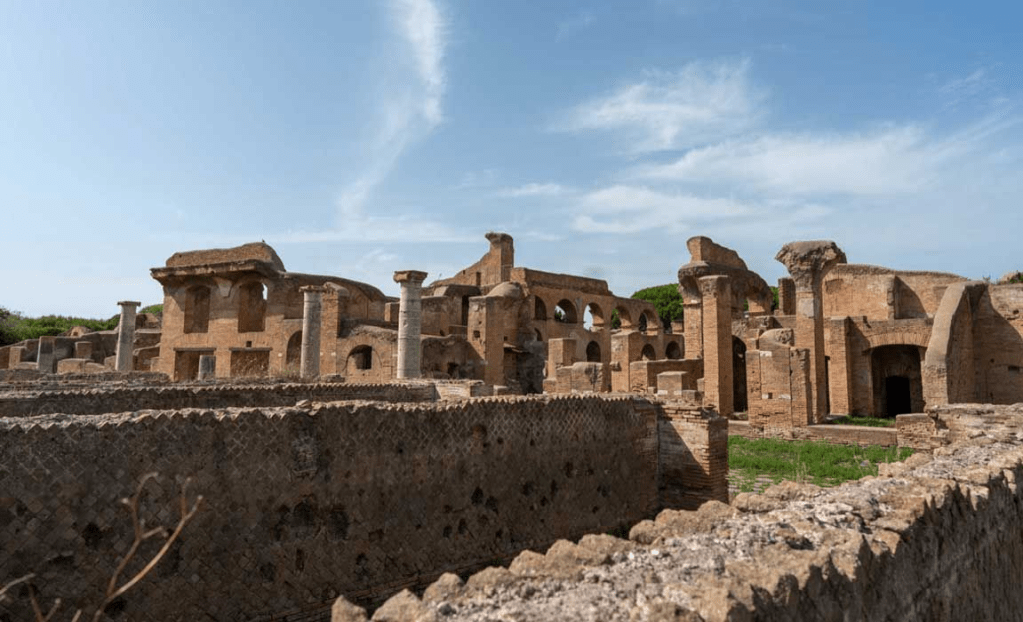
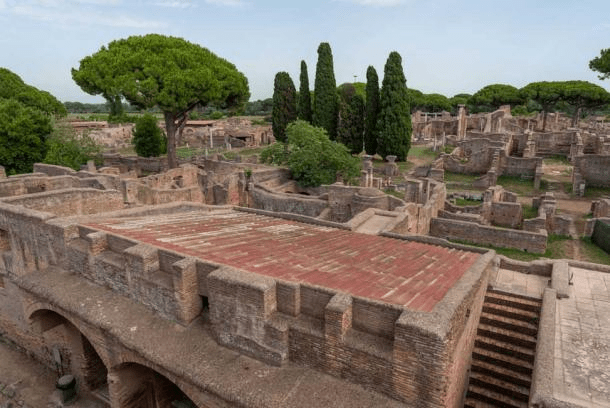
Present-day Ostia Antica / https://www.pinterest.com/pin/364650901081777485/ The ancient Romans consider Ostia Antica as their first colony and was founded by Ancus Marcius, who was the fourth king of Rome. He ruled from 640-617 BCE, in which he is said to have founded Ostia Antica about 620 BCE. Due to the fact that some of the site has yet to be discovered, some scholars believe that there was a settlement by the 7th century BCE. It is believed to have been a small outpost, to mark conquered territory. The oldest infrastructure found in Ostia Antica was a road, which has been dated to the 6th or 5th century BCE. This road stretches from the mouth of the Tiber River and continues Southeast. The first structure built at Ostia Antica is called the Castrum. The Castrum was built between 349 and 338 BCE. During this period, Rome was under the threat of pirates and was at war with neighboring societies. It is assumed that Ostia Antica was primarily serving as a naval base during this time period. This is not the only time it has served this purpose, as during the Punic Wars, it served as the main base on the west coast of Italy. After the wars were over, it was converted into a commercial harbor for trade. This is said to occur due to Rome’s growing population and great military success. The port was a central trading hub for societies such as Sicily, Sardinia, and Africa at times. Unfortunately, most of the structures that were built during this period were destroyed because it was completely rebuilt during the 2nd century CE.
A military fortress in Ostia Antica / https://www.ancient-origins.net/ancient-places-europe/ostia-antica-0012792 Roman mosaics were a common architectural and artistic feature that could be found throughout the empire. They could be found in wealthy, private homes or in public buildings. Some were decorative, while others were built on the floor to provide a durable walking surface. Due to the fact they were walked on, they were made of durable materials such as tesserae, which is a small block of stone tile. This led to archaeologists discovering numerous floor mosaics, making them one of the more common relics found in Ostia Antica. These mosaics were built for the upper class people, which usually depicted some form of royalty or a god. They were built by slaves and lower class workers. Another use of mosaics in Ancient Rome was advertisement. An example of this is located in the Forum of the Guilds. The guilt consisted of merchants, ship-owners, suppliers, importers, and exporters. For the decorative mosaics, most of the preserved mosaics were shipped off to museums, but few still remain on the walls of the complex.
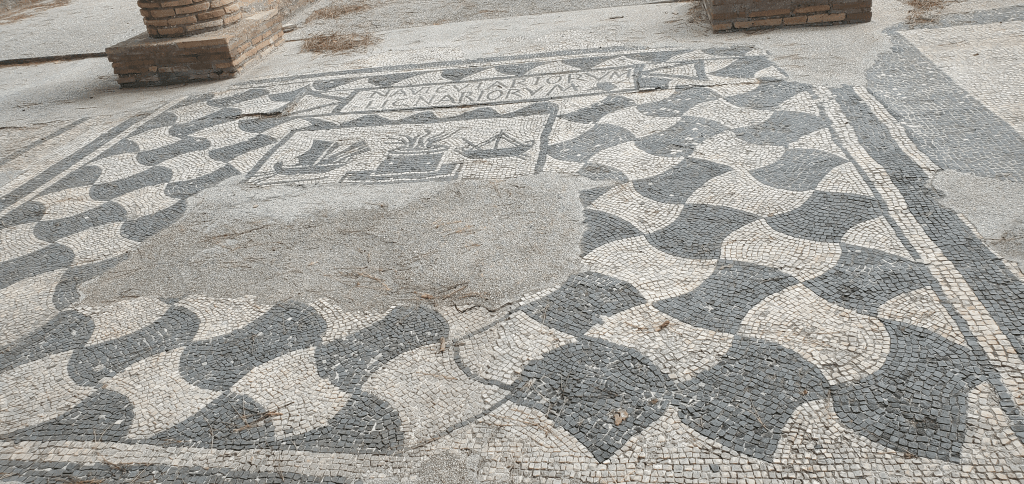
The floor mosaic I have chosen / https://calverthall.myschoolapp.com/ftpimages/274/download/download_7672728.jpg In conclusion, Ostia Antica served as an important city for Rome for several centuries. It served as a commerce center and naval base for certain time periods. It consisted of various forms of art, with mosaics scattered throughout the remains of the city. This includes floor mosaics, which provided a stable walkway, and decorative mosaics, in which most of them have been shipped away. Overall, the design and depictions of the mosaics show the values and important figures in an Ancient Roman society.
Video:
Ostia Antica, Italy: Peek into Ancient Rome – https://www.youtube.com/watch?v=BiCUFlLFazY
Sources:
https://www.ancient-origins.net/ancient-places-europe/ostia-antica-0012792
https://gallivance.net/2014/01/20/mules-gods-and-ad-men-ostia-anticas-mosaics/
-
The Pergamon Mosaic: An Analysis of Ancient Art

Psittacula eupatria depicted in the Pergamon Hellenistic Mosaic (2nd Century BCE) The Pergamon Hellenistic Mosaic was made around the 2nd century BCE. It was rediscovered by Richard Bohn and his archeological team of investigators, in the Altar Room, otherwise known as the Telephos Hall, of Palace V, located in the Pergamon Acropolis, on June 28, 1886. The mosaic itself depicts a member of the species Psittacula eupatria, otherwise known as Alexandrine parakeet, which is named after Alexander the Great. The mosaic also depicts other wildlife, such as garlands that are comprised of fruit, flowers, and leaves. Other animals such as nightingales, woodpeckers, wheateaters, and butterflies are shown in different areas of the mural.

A Portion of the Pergamon Hellenistic Mosaic (2nd Century BCE) Ancient mosaics were used to festoon buildings of importance such as churches and mausoleums. Evidently, there is a religious significance heavily related to mosaics in ancient times. The Pergamon Hellenistic Mosaic itself was discovered in an alter room, further exemplifying the cultural importance of ancient mosaics.
This piece of art is an example of a mosaic in the style commonly referred to as “opus vermiculatum,” a Latin term that essentially translates to “worm-like work” in English. The tiles themselves are square shaped stones or cube-like fragments of glass, each of which are lined up in rows to create the picture. The materials of mosaics at the time were designed and used to emulate paintings. For the most part, the main subject of the picture was composed of many different colors, all of which were remarkably vibrant. These bright colors were usually surrounded by a dark embroidery to add further emphasis to the dynamism of the image’s focus through contrast. It is believed that the artists of these of mosaics made the actual mosaic in their own workshops before they transported the then complete mosaic to the spot where they were eventually cemented in by concrete and mortar. This process was known as emblemata. The use of this method allowed for the preparation of small and easy to access works that could moved whenever possible to a floor or wall. This also allowed for more adaptability in the event that an unseen occurrence appeared and hindered installation.
Occasionally, mosaic artwork was signed by the artist. For example, the first known artist to sign one of his works was Gnoseis, with his Stag Hunt mosaic floor in the House of the Abduction of Helen, located in Pallas, Greece. Other mosaics at the Pergamon Acropolis bear the signature of Hephaistion, although it is uncertain for sure if he worked on the Pergamon Hellenistic Mosaic. There is also another mosaic artist dated to be working the Pergamon around the same time of the artwork’s constriction. The ancient Roman author Pliny the Elder writes about a mosaic artist named Sosos. However, there are currently no known attributed works created by Sosos.

Hephaistion’s Signature from Palace V in Pergamon Acropolis (2nd Century BCE) The modern rendition of the mosaic is actually a partial reconstruction of the original artwork, with pieces from other mosaics being incorporated into the artwork wherever seen fit. The major focus point itself, the parrot, is a completed copy that was finished in 1955, since the original was damaged and only exists in a few pieces. When the original version was removed from the Pergamon Acropolis, the condition of the mosaic began to degrade; thus, a copy was promptly made to demonstrate the artwork. The copy of the mosaic is on display at the Pergamonmuseum, Staatliche Museen zu Berlin, located in Berlin, Germany.
Arcticle that provides additional information on Ancient Mosaics in religious buildings: https://earlychurchhistory.org/arts/mosaics-in-the-ancient-world/
Bibliography
https://artsandculture.google.com/asset/parrot-mosaic-unknown/dAHr0Sez7P1WiA?hl=en
http://hdl.handle.net/1721.3/146676
http://www.my-favourite-planet.de/english/middle-east/turkey/pergamon/pergamon-photos-02-012.html
-
Ostia Antica: The Creation and Culture of the Ocean’s Mosaic
Matthias Pridgeon
The mosaic located in the once Roman city of Ostia Antica depicts many mythological associated with the ocean and the industries connected to it. The figures and creatures, and even buildings and vehicles, all represent various specific aspects of the ocean and associated items. The massive mural is an impressively detailed and varied piece which provides a snapshot of the time’s culture and values.
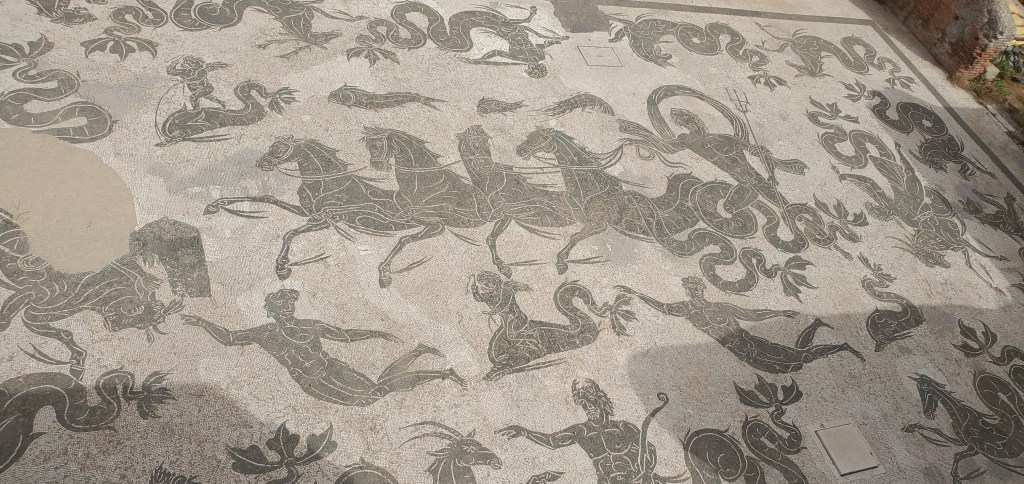
The mosaic at Ostia Antica. This specific piece is the impressive height of Ostia Antica’s unique artistic style and theming. This style was defined by very small tiles of black and white, which were arranged in very elaborate and creative ways. Though this style may sound limited, the mural above is a superlative example of the incredible intricacies this style could produce. Though the creator, or creators, of this preeminent mural remains anonymous, their great skill is apparent when comparing it to the other murals contemporary in location and time, such as the one below.
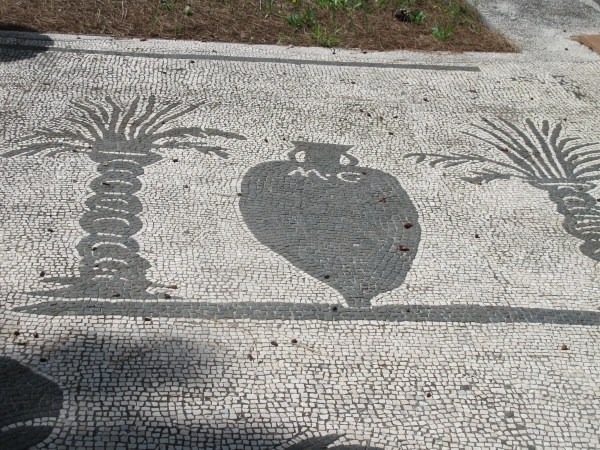
An amphora, or jar, standing between a pair of palms. Though the black and white materials may seem limiting to the modern viewer, they were very important for creating a cohesive style between the many, many, murals of the city. Additionally, the small size of the tiles allowed for a surprising amount of detail, far more than many other, larger tiled pieces found in other areas.
The style was important for use in definition by the common citizen of Ostia Antica, as the murals were often utilized as shop signs or public signifiers. This style was used ubiquitously by merchants and officials within the city, and so assisted with clarity, as well as providing merchants with a simple medium to express their shops’ purchase. Even if one was not incredibly talented, with colors or intricate designs spread across large tiles, they small tiles were easy to arrange in basic shapes, without needing to etch or draw designs, and the limited color gradient eliminated the need for knowledge of colors.
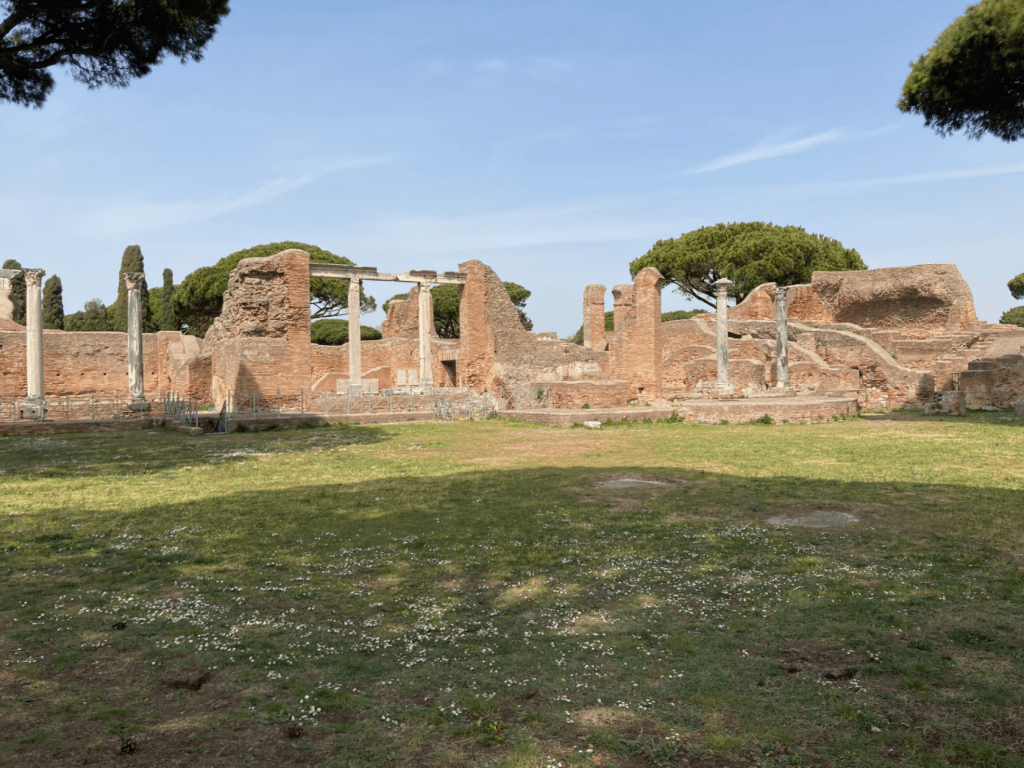
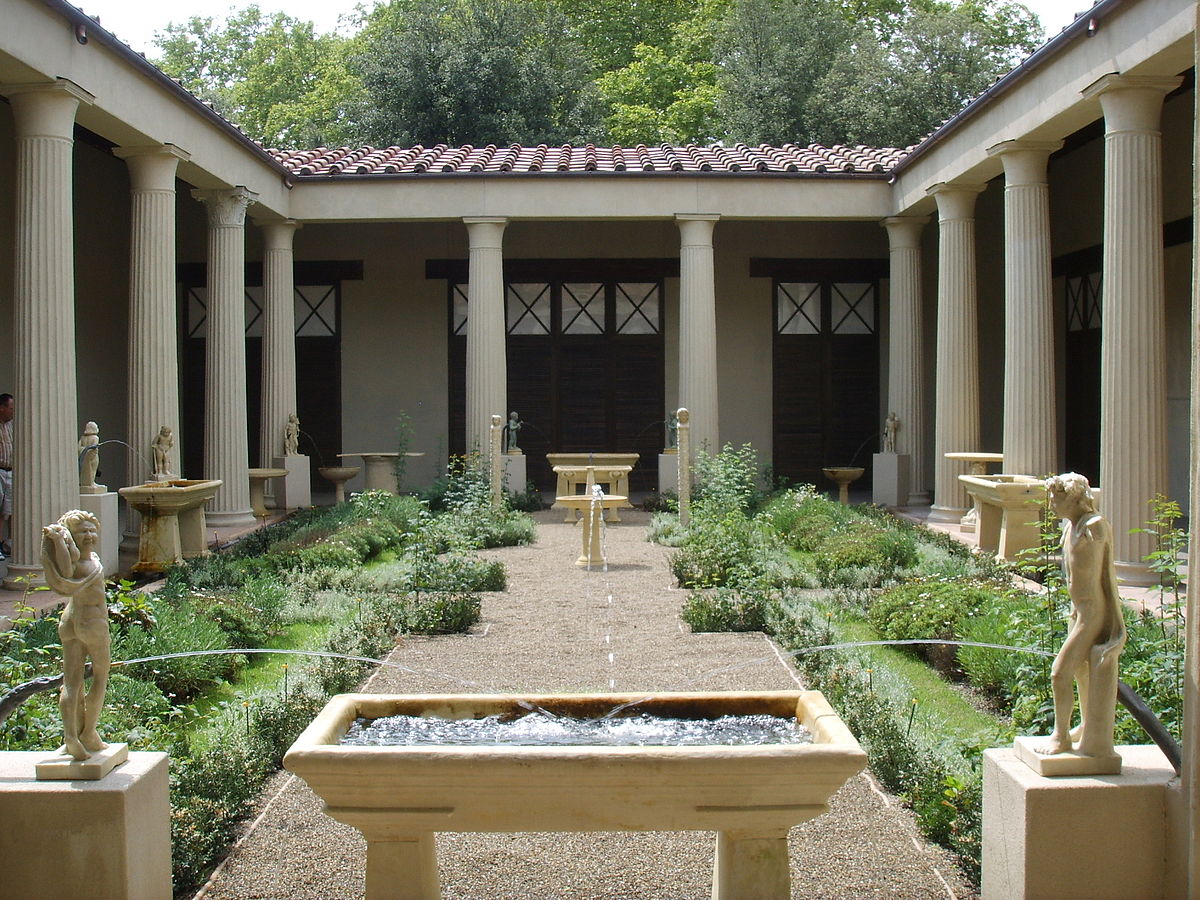
Bathouse in Ostia Antica, now ruins. Other mosaics were used to decorate public amenities, such as bath houses or restrooms. Often, they were crafted along the floor of the buildings, especially around the doorways, which were seen as important places of transition to the Romans, as well as the domain of their two-faced God (literally), Janus. But the most highly detailed and captivating were placed at the bottom of pools, especially those which related to the denizens or deities of the sea. The main focus of my project, the first image shown, was placed at the bottom of the central pool of a highly prestigious public area: Neptune’s Bath House.
These public mosaics, more so than those that were utilized by merchants or public officials, were a way of venerating their deities. This is why they so often depicted Gods, demi-Gods, or those they saw as possible champions of the Gods, such as athletic champions. Artistic mediums were an important form of offering, as it preserved the likeness of those worshipped for possible eternity; additionally, it placed important figures in the public eye, as they were placed in areas of frequent traffic.
As Ostia Antica was a port city, the mosaics often revolved around nautical affairs, and focused on respecting maritime creatures and gods. The cosmopolitan nature of trading ports also brought cultural exchange, which is reflected in the mosaics. Though the gods were usually consistent, as it was sacrilegious to deviate, creatures were more variable. Creatures based in non-Roman myths, or even freshly generated in the human imagination, were included in these mosaics.
To capture these fascinating creatures, I will be using paint as my primary medium. The black and white paint, done over pencil sketches, will allow for the intricate line and shape detailing which defines this mosaic. As a base for my recreation, I will be using thin foamboard, such as that used in some tri-fold poster boards. This material will allow me to score lines, roughly half an inch apart, to create a tiled effect without destroying the aforementioned line work. Also, this material will prevent the extra labor of re-glueing the cut pieces to a backing, as I should be able to cut only partially through, and so maintain a solid form.
The mosaics of Ostia Antica, defined by their small tiled and di-colored style, were used as both functional utilitarian designators and artistic demonstrations of faith in the gods; through them, much about the cosmopolitan and maritime culture is revealed. Learn more about the extreme variety of subject matter within other Ostia Antican mosaics here: https://spanishstepsapartment.wordpress.com/2018/06/30/ostia-anticas-black-and-white-mosaics/.
Works Cited:
-https://johnsusansexcellentadventure.com/
-https://gallivance.net/2014/01/20/mules-gods-and-ad-men-ostia-anticas-mosaics/
-https://spanishstepsapartment.wordpress.com/2018/06/30/ostia-anticas-black-and-white-mosaics/
-https://www.sciencephoto.com/media/185868/view/roman-mosaic-ostia-antica -
Posavec: The Parrot Pergamon: The Background
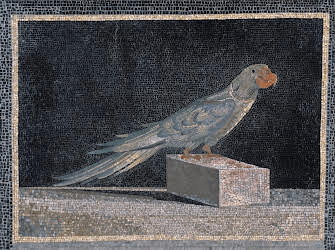
Parrot Pergamon mosaic (early to mid-2nd century BCE) originally located in Pergamon Palace V The exact date of the Parrot Pergamon although unknown is predicted to have been made sometime from the early to mid-2nd century BCE. It was originally a floor mosaic in the last royal palace built in Pergamon. It was a part of a larger floor mosaic but was removed during ancient times. After its removal, the mosaic was very damaged so they made a new copy to be displayed in a museum. The only remnants of the original are a piece of the bird’s neck and some tail feathers.
The creator of the mosaic is unknown. This is a common theme in all of the art in the Pergamene acropolis as it was mysteriously constructed with few historical records. However, we do know the temple itself was constructed by King Eumenes I. It was constructed in Pergamon which is where modern-day Bergama is located. The mosaic is now located in Berlin along with the rest of the temple.
Despite not knowing the exact artist, in the same building where the Parrot mosaic was kept, there was a fragment of the central panel that is a piece of paper with a signature on it that reads, “Hephaistion”. Although most of it was destroyed the remains are still kept in a museum in Berlin.
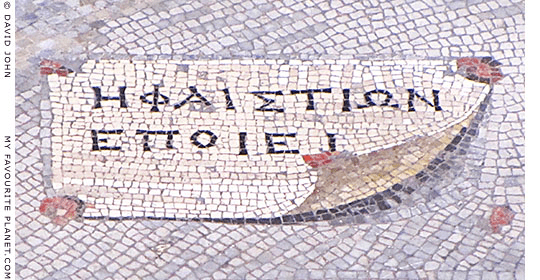
Hephaistion’s signature (2nd century BCE) originally located in Perganom Palace V Although the artist is unknown we do know why the artist made the mosaic of the Alexandrine parakeet specifically. The bird is named after Alexander the Great to honor his actions of sending many exotic birds from Punjab to the west. This is most likely why the mosaic was in the palace as the exotic birds were mainly purchased by very wealthy people who would be able to build palaces.
The parrot is considered to be made using the technique known as opus vermiculatum, “worm-like”. This technique originates from Greece and was used in other impactful mosaics such as the one below which is the central emblemata of a floor mosaic in Rome. The way these mosaics are made is by forming rows of colored tesserae. A method used when making these was to make the centerpiece more vibrant by surrounding it with a dark border to enhance the color towards the middle. This allowed for opus vermiculatum mosaics to be much more realistic and closer to paintings than other forms.

Mosaic of a cat trying to catch a bird in flight (1st quarter of the 1st century BCE) originally located in Via Ardeatina These mosaics as I briefly mentioned are called emblematas. What this means is that before being cemented into the site and put into the larger mosaic the artist would craft it and then transport it to the site. This method was very beneficial for the artist as it allowed them to create small pieces at a time without worrying about fixing them in place.
Pergamonian mosaics were overall very innovative and creative. They provide a very different style of mosaic that is very realistic and requires very meticulous craftsmanship. Although we can never truly know the meaning of these pieces of art due to the anonymity of the artists we can still learn from and honor them as the brilliant artistic feats they are.
Interesting video about opus vermiculatum: https://www.youtube.com/watch?v=u0rDj-hOViM
-
Subscribe
Subscribed
Have a WordPress.com account? Log in now.

